Celestron
StarSense Explorer 10" Dobsonian
SKU:
Low stock: 1 left
Couldn't load pickup availability
StarSense Explorer 10" Dobsonian — The Telescope You Buy Once and Use for Life | Sky Deep Co
Most people spend years learning how to find faint galaxies manually. With the Celestron StarSense Explorer 10" Dobsonian, you skip that entire learning curve. On your very first night, you can point this telescope at the Whirlpool Galaxy, the Ring Nebula, or the globular cluster M13 — and actually find them.
This is a 10-inch Dobsonian telescope. Ten inches of mirror is a serious amount of light-gathering power. Astronomers worldwide consider this the sweet spot — large enough to show you things that genuinely surprise you, but still manageable enough to set up and move on your own. Sky Deep Co carries this as Pakistan's only authorized Celestron dealer, so what you receive is a genuine product with full warranty and real after-sales support.
Why Aperture Is the One Number That Changes Everything
Before anything else, let us talk about the mirror inside this telescope. The aperture is 254mm — that is exactly 10 inches. Aperture is simply the diameter of the primary mirror. And that one number determines more about your viewing experience than any other specification.
Here is why it matters so much. A larger mirror collects more light from the sky. More light means fainter objects become visible, brighter objects show more detail, and higher magnifications stay sharp instead of going soft and washed out. The StarSense Explorer 10" Dobsonian gathers 1,317 times more light than your naked eye. Stars your eye cannot see at all become sharp bright points through this mirror.
Compare that to the StarSense Explorer 150 Tabletop Dobsonian which gathers around 460 times more light, or the StarSense Explorer 130 Tabletop Dobsonian at around 345 times. The jump from 6 inches to 10 inches is not small — it is a completely different category of observing. Objects that were faint smudges through a smaller telescope become structured, detailed, textured things you can actually study through 10 inches of glass.
The focal length is 1200mm at f/4.7. This is a fast focal ratio, which gives you bright images across a wide field of view. The limiting stellar magnitude is 14.7 — meaning objects 14.7 magnitudes faint are within reach. Most deep-sky objects that serious observers chase fall well within that range. The highest useful magnification is 600x, and the lowest is 36x, giving you an enormous range of observing options from wide sweeping views to tight planetary close-ups.
The Mirror Material Is Not an Afterthought
The primary mirror in the StarSense Explorer 10" Dobsonian is made from Pyrex equivalent glass. This matters more than most buyers realize. Regular glass expands and contracts as temperature changes. When you take a telescope outside on a cool Pakistani night, the mirror needs time to reach the same temperature as the surrounding air — a process called thermal equilibration. Glass mirrors can take a long time to settle, meaning your first 30 to 60 minutes of observing can show slightly blurry images as the mirror adjusts.
Pyrex equivalent glass has a much lower coefficient of thermal expansion. It stabilizes faster, which means your views sharpen up sooner after you set up. On a cool winter night in Lahore or at altitude near Murree, this makes a real practical difference.
The mirror is 30mm thick — roughly a 1:8 thickness ratio. That is substantial enough to hold its parabolic shape under its own weight without flexing as you tilt the telescope toward different parts of the sky.
Both primary and secondary mirrors are coated with Celestron's XLT reflective coatings, plus silicon dioxide and tantalum pentoxide protective overcoatings. This combination maximizes light transmission and protects the mirror surface from humidity, dust, and the general atmosphere of Pakistan. If you want to understand more about how mirror coatings affect image quality, the Astro Knowledge Hub covers this in detail written specifically for beginners.
Plate Solving — What StarSense Actually Does Under the Hood
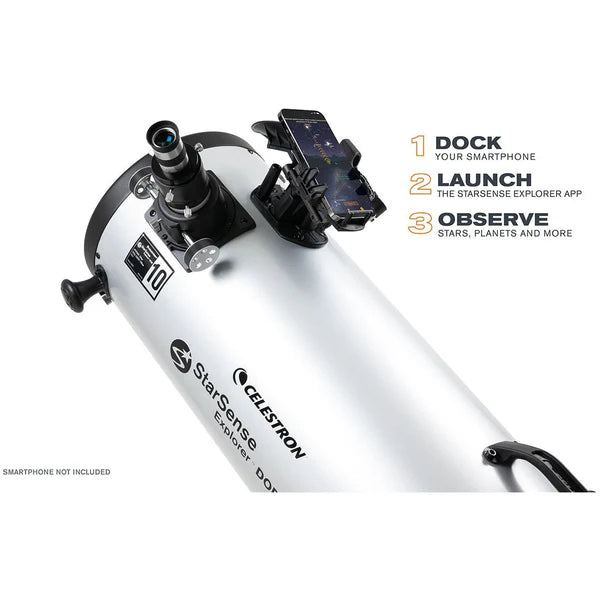
The StarSense Explorer app uses a process called plate solving. This is worth understanding because it is genuinely clever and it is why the system works so much better than competing apps.
When you dock your smartphone and open the app, it uses your phone's camera to capture an image of the night sky. It then identifies the star patterns in that image and matches them against its internal database of known star positions. From that match, it calculates exactly where your telescope is pointed — right now, with no input from you about your location, no alignment on specific stars, and no reliance on your phone's magnetic compass or motion sensors.
This is called plate solving because early astronomers used glass photographic plates, and identifying objects on those plates was called solving the plate. The same mathematical process now runs in seconds on your smartphone. Big professional observatories have used this technique for decades. The Hubble Space Telescope uses a version of it. Celestron brought it to a manual Dobsonian, and it actually works exactly as advertised.
Once the app knows where the telescope is pointing, it shows you arrows on screen. You follow those arrows by physically moving the telescope with your hands. When the bullseye turns green, look through the eyepiece. Your target is there. This is how people with zero star chart experience find the Virgo Galaxy Cluster or the Veil Nebula on their first night out. Our Large Telescopes collection has more options if you want to compare before deciding.
The Focuser Deserves Its Own Mention
Most Dobsonians in this price range include a rack-and-pinion focuser. It works, but it has a problem called focus shift — as you rack the focuser in or out, the eyepiece slightly shifts position, which moves the object out of the center of your view. At high magnifications this becomes genuinely annoying.
The StarSense Explorer 10" Dobsonian includes a 2-inch Crayford focuser. The Crayford design uses a roller mechanism instead of a gear rack. It moves smoothly with no backlash and no focus shift. When you find the sharpest focus and stop moving the focuser, the image stays exactly where it was. There is also a thumbscrew that locks the focuser in place so nothing slips during observation.
The focuser accepts 2-inch eyepieces, which is important. Two-inch eyepieces provide a wider field of view than 1.25-inch eyepieces at the same magnification. A 2-inch to 1.25-inch adapter is included so you can use your existing 1.25-inch eyepieces too. When you are ready to expand your eyepiece collection, Sky Deep Co carries a full range of Eyepieces and Barlows to complement this telescope.
The Base: Built Heavier Than Most 10-Inch Dobsonians
A 10-inch mirror is heavy. The base that holds it needs to be solid enough that the telescope does not wobble when you touch it, yet smooth enough that you can guide it with fingertip pressure while following the app arrows.
Celestron built the base on this telescope with larger diameter altitude bearings than most competing 10-inch Dobsonians. Variable altitude tensioning lets you adjust how much resistance the telescope has as you tilt it up and down — tighter for high magnification work where small movements are more noticeable, looser for casual scanning. The azimuth bearings use Teflon pads, which give smooth rotation without sticking or jerking. Side panel braces add extra rigidity to the base structure, reducing flex when you nudge the telescope.
Both the optical tube and the base have carry handles. You can separate the two parts for transport and carry each one independently. The base is essentially a box you set on the ground. The tube sits on top. Two people can have this fully assembled and observing in under 10 minutes. One person can manage it too, but having a second person helps with the optical tube.
What You Will Actually See Through 10 Inches of Aperture
The Moon through this telescope looks like a photograph. You can trace individual crater walls, see mountains casting long shadows across crater floors, and follow the terminator line in detail that makes you forget you are looking at something 384,000 kilometers away.
Planets are where the 10-inch aperture starts separating itself from smaller telescopes. Saturn shows not just its rings but the Cassini Division — the dark gap between the A and B rings — clearly and consistently. Jupiter's cloud bands have internal structure. The Great Red Spot shows as a distinct oval, not just a smudge. Mars, even when it is not at opposition, shows surface markings and polar ice caps on good nights.
Deep-sky objects are where this telescope does something genuinely different from a 6-inch. The Orion Nebula does not just glow — it has wispy filament structure in the outer regions. The Andromeda Galaxy M31 shows dust lanes. M13, the Hercules Globular Cluster, starts resolving into individual stars across its core. The Whirlpool Galaxy M51 shows hints of its spiral arms. The Ring Nebula M57 shows as a clear smoke ring with a faint central star visible on excellent nights.
From a dark sky site 30 to 40 minutes outside Lahore, Karachi, or Islamabad, this telescope will show you more objects in one night than most people observe in a lifetime with a smaller telescope. Our Astro Learning Hub has observing guides to help you plan exactly what to look at each season.
Who StarSense Explorer 10" Dobsonian Is Really For
The StarSense Explorer 10" Dobsonian is not an impulse purchase. It is for someone who has thought about this seriously and wants a telescope they will not outgrow. Maybe you started with a smaller telescope and you want significantly more capability. Maybe you are buying your first telescope and you want to start at a level that gives you room to grow as an observer for the next 10 to 15 years.
It is also for families where one serious person wants a proper instrument. Children and adults alike can use the StarSense app to find objects — but the views through 10 inches of mirror will impress even experienced observers.
If you are still deciding between different sizes, compare this against the StarSense Explorer 150 Tabletop Dobsonian or browse our Advanced Level Telescopes collection to see how this fits within the wider range of serious instruments Sky Deep Co carries. Our Intermediate Level Telescopes collection is also worth browsing if you want to see the options between entry-level and this.
Everything That Comes in the Box
The package includes the StarSense Explorer 10-inch Dobsonian optical tube with 254mm parabolic primary mirror, XLT coatings, and Pyrex equivalent glass. You also get a 25mm Plössl eyepiece which gives you 48x magnification, a 2-inch Crayford focuser with 2-inch extension tube and 2-to-1.25-inch adapter, the StarSense smartphone dock, a StarPointer red dot finderscope, an eyepiece rack attached to the tube, dust covers for the primary mirror and focuser, and a collimation tool. The StarSense Explorer app is free on iOS and Android.
FAQs
How does the 10-inch compare to the tabletop Dobsonian versions and is the size jump worth it?
The tabletop versions — the 130mm and 150mm — are excellent portable telescopes for casual and beginner observing. The 10-inch is a different class of instrument. The light-gathering difference between 150mm and 254mm is significant — you are collecting nearly three times more light. Deep-sky objects that are faint smudges through 150mm become structured, detailed views through 10 inches. The trade-off is size, weight, and price. The tabletops are easier to move and store. The 10-inch requires more commitment. If you are serious about deep-sky observing and plan to use the telescope regularly, the 10-inch is the better long-term choice.
Is a 10-inch Dobsonian practical in a Pakistani city?
Yes, with some planning. The telescope separates into two parts — the base and the optical tube — each with carry handles. You can transport it in a car comfortably. Many Sky Deep Co customers in Lahore and Karachi observe from rooftops, open fields at the edge of the city, or parks. Even from a light-polluted city you get excellent views of the Moon and planets, which are genuinely impressive through 10 inches. For deep-sky objects, a drive to a darker area outside the city makes a large difference. The StarSense app works anywhere and adjusts automatically to your location.
Collimation on a fast f/4.7 telescope — how difficult is this really?
Collimation on an f/4.7 telescope is slightly more critical than on slower focal ratio instruments like an f/8. This means small misalignments affect image quality more noticeably. The good news is that the 10-inch does not require a screwdriver for primary mirror adjustment — three accessible screws on the back of the tube handle it directly. Most observers collimate before each session, and with practice it takes under 5 minutes. The included collimation tool helps. Sky Deep Co's Astro Knowledge Hub has a step-by-step guide on Dobsonian collimation written in plain language.
What eyepieces should I add beyond the included 25mm Plössl?
The included 25mm Plössl gives you 48x magnification — a good starting point for large deep-sky objects and wide star fields. To get more from this telescope you will want a medium magnification eyepiece around 10mm to 15mm for galaxy detail and star clusters, and a higher power eyepiece around 6mm to 9mm for planetary work and globular cluster resolution. The 2-inch Crayford focuser also opens the door to 2-inch wide-field eyepieces, which give spectacular sweeping views at low magnification. Sky Deep Co carries a wide range of Eyepieces and Barlows matched to telescopes like this one.
Is Sky Deep Co authorized to sell Celestron in Pakistan and what does that mean for my purchase?
Sky Deep Co is the only authorized Celestron dealer in Pakistan. An authorized dealer means the product you receive is genuine, comes with the manufacturer's warranty, and is supported by Celestron's official supply chain. Parallel imports from unauthorized sources have no warranty, may have been stored or transported incorrectly, and have no official support if something goes wrong. When you order the StarSense Explorer 10" Dobsonian from Sky Deep Co, you also get free nationwide delivery, a pre-order option with 10 to 20% advance if stock is limited, and access to our team for any questions before or after your purchase. We are also the official learning partner of the Lahore Astronomical Society, which means our astronomy knowledge is verified by Pakistan's leading astronomy community.
Take the Next Step With Sky Deep Co
The StarSense Explorer 10" Dobsonian sits at the top of the StarSense Dobsonian range. But Sky Deep Co carries astronomy equipment at every level. If you want to explore the full Dobsonian family, visit our Dobsonian Telescopes collection. If you are interested in astrophotography as a next step after visual observing, our Deep Space Imaging and GoTo Computerized Mounts sections show you what that path looks like. Browse all Celestron products we carry, or visit our Home Page to see everything.
Questions before you decide? Contact us directly. Want a one-to-one conversation about whether this is the right telescope for your situation? Book a Free Consultation — our team has been answering exactly these questions for Pakistani astronomy customers long enough to give you a straight honest answer.
StarSense Explorer 10" Dobsonian You Buy Once and Keep for Life
The Celestron StarSense Explorer 10" Dobsonian is available at Sky Deep Co for Rs. 472,380 PKR with free nationwide delivery across Pakistan.
Stock is very limited — only 1 unit currently available. The next shipment takes 4 to 6 weeks after this sells out.
Sky Deep Co is Pakistan's only authorized Celestron dealer. We are the official learning partner of the Lahore Astronomical Society. We are Pakistan's first astronomy imaging and learning hub. Every telescope we sell is a genuine product. Every customer gets real support. We have been doing this long enough to know that a 10-inch Dobsonian, used regularly under Pakistani skies, changes how a person sees the world — literally.
Add to Cart — Rs. 472,380 PKR
Not ready yet? Book a Free Consultation and talk it through with our team. Or message us on our Contact Us page. We reply fast, and we never push you toward a purchase you are not confident about.