Skip to product information
1 of 1

Sky Deep

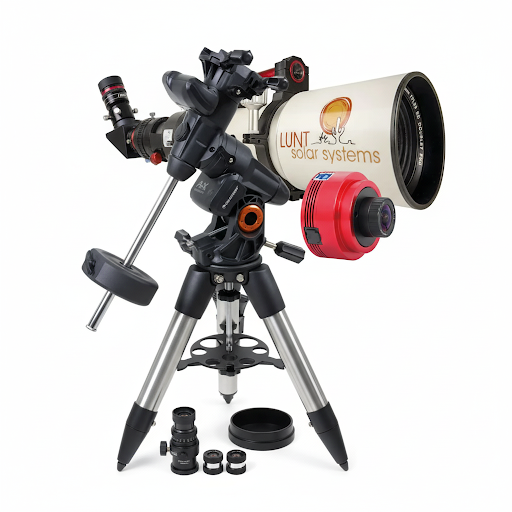
Solar Imaging Bundle

Solar Imaging Bundle

Regular price Rs.1,567,500 PKR
Regular price Sale price Rs.1,567,500 PKR
Sale Sold out

SKU:Solar/Lunar/Planetary-004

In stock

Quantity

Most people think astronomy means night time. Dark sky, no moon, deep space objects. But there is a whole other world to explore. You can image the Sun. And when you do it right, the results are absolutely stunning. The Solar Imaging Bundle from Sky Deep gives you everything you need to capture the Sun in incredible detail. Prominences, filaments, sunspots, surface granulation — all of it becomes visible with this setup.

This is not a casual bundle. This is a dedicated H-alpha solar imaging system. Every piece of equipment in this bundle is chosen for one specific purpose — serious solar photography. Let's break it down completely so you understand exactly what you are getting and why it works so well.

What Is the Solar Imaging Bundle?

The Solar Imaging Bundle combines four premium pieces of equipment into one ready-to-use solar imaging system. You get a dedicated H-alpha solar telescope, a computerized German equatorial mount, a high-speed color planetary camera, and a powerful Barlow lens. Together, these four components form a complete solar imaging rig that works from your rooftop in Pakistan without needing anything extra.

The bundle is priced at Rs. 1,567,500 and is available with free nationwide delivery from Sky Deep, Pakistan's only authorized ZWO and Celestron dealer. You can visit the product page directly or reach the team through the Contact Us page for a free consultation before ordering.

Why H-Alpha Solar Imaging?

Before we go into each component, you need to understand what H-alpha means and why it matters.

White light solar filters show you sunspots. That is it. The surface looks flat and simple. But H-alpha is different. H-alpha stands for Hydrogen-Alpha. It is a very specific wavelength of red light — 656.28 nanometers to be exact. The Sun emits a huge amount of energy at this wavelength. When you filter the Sun to show only this wavelength, a completely different world appears.

You can suddenly see solar prominences. These are huge arcs of plasma that shoot out from the Sun's edge. Some prominences are larger than the entire Earth. You can also see filaments, which are the same structures but seen against the solar disk. Surface granulation becomes visible too — the boiling, churning surface of the Sun that looks like a giant orange peel. Plages appear as bright active regions around sunspots.

None of this is visible in white light. H-alpha imaging reveals the Sun's true dynamic nature. And the Solar Imaging Bundle is built specifically for this type of imaging.

Component 1 — Lunt LS80MT H-Alpha Solar Telescope

This is the heart of the Solar Imaging Bundle. The Lunt LS80MT is a dedicated H-alpha solar telescope. It is not a regular telescope with a filter attached. It is purpose-built for solar work from the ground up.

Aperture and Optics

The LS80MT has an 80mm aperture. For solar imaging, 80mm is a very capable aperture. It gives you excellent resolution for capturing fine surface detail. The optics inside are specifically designed to transmit H-alpha light with maximum clarity.

Internal Etalon System

This is the most important technical feature of the LS80MT. An etalon is a precision optical device that passes only a very narrow bandwidth of light. The Lunt LS80MT uses an internal etalon. This means the etalon sits inside the telescope tube itself, not as an external attachment.

Internal etalon design gives you better thermal stability. When the etalon stays inside the tube, it is protected from wind and temperature changes. This keeps the bandpass consistent throughout your imaging session. Consistent bandpass means consistent contrast in your images.

The bandpass of the LS80MT etalon is less than 0.75 Angstroms. To put that in perspective, 1 Angstrom is one ten-billionth of a meter. The etalon passes an incredibly thin slice of light. Only H-alpha wavelengths pass through. Everything else is blocked. This is what gives you that dramatic contrast in solar images.

Blocking Filter

The LS80MT includes a dedicated blocking filter. This filter sits at the focuser end of the telescope. It blocks any remaining off-wavelength light that the etalon did not catch. Together, the etalon and blocking filter create a safe, high-contrast H-alpha optical system.

Important safety note: Always use the blocking filter when observing or imaging the Sun with this telescope. Never look through any solar telescope without proper filters in place. The LS80MT is designed to be used as a complete system. Do not remove or bypass any included safety components.

Tuning System

The Lunt LS80MT etalon is pressure tunable. This means you can fine-tune the exact wavelength the etalon passes by adjusting air pressure inside the etalon housing. Small adjustments shift the bandpass slightly. This lets you optimize contrast for different solar features. You can tune for maximum prominence visibility or tune for surface granulation detail depending on what you want to capture.

Component 2 — Celestron Advanced VX Computerized German Equatorial Mount

The mount is just as important as the telescope. For solar video imaging, you need smooth, accurate tracking. The Solar Imaging Bundle includes the Celestron Advanced VX, also called the AVX mount.

German Equatorial Design

The AVX is a German Equatorial Mount, or GEM. This type of mount aligns one axis with Earth's rotational axis. When you do this correctly, the mount compensates for Earth's rotation automatically. The Sun stays centered in your camera frame for long imaging sessions without constant manual adjustment.

This matters a lot for solar imaging. You capture the Sun as a video — hundreds or thousands of frames stacked together. If the Sun drifts out of frame during capture, you lose data. The AVX tracks the Sun smoothly and keeps it steady throughout your session.

GoTo Computerized System

The AVX has a built-in computerized GoTo system. You enter the location, date, and time. The mount aligns itself and then points directly at the Sun on command. For solar work, the AVX has a dedicated Solar tracking rate. Earth rotates once in 24 hours. The Sun appears to move slightly slower than stars because of Earth's orbital motion. The Solar tracking rate accounts for this difference and keeps the Sun precisely centered.

Payload Capacity

The AVX handles up to 30 lbs of equipment. The LS80MT and camera combination sits well within this limit. This gives you room to add a guide camera or other accessories later without overloading the mount.

Stability and Vibration Damping

Solar imaging uses short exposures — typically a few milliseconds per frame. However, vibration still affects image sharpness. The AVX tripod and mount head are solid enough to dampen vibrations quickly. After you release the focuser or make an adjustment, vibrations settle within one or two seconds. This keeps your video frames clean and sharp.

Component 3 — ZWO ASI676MC Color Planetary Camera

The camera in this Solar Imaging Bundle is the ZWO ASI676MC. ZWO is the world leader in astronomy cameras, and Sky Deep is Pakistan's only authorized ZWO dealer. This specific camera is chosen for solar and planetary imaging because of its sensor characteristics.

Sensor — Sony IMX676

The ASI676MC uses the Sony IMX676 sensor. This is a back-illuminated CMOS sensor. Back-illuminated means the light hits the sensitive part of the sensor directly without passing through wiring layers first. The result is higher sensitivity and lower noise. For H-alpha solar imaging, sensitivity matters. H-alpha light is in the red part of the spectrum. The IMX676 has excellent red sensitivity, which makes it ideal for H-alpha work.

Resolution and Pixel Size

The IMX676 sensor has a resolution of 26 megapixels. The pixel size is 2.9 microns. Smaller pixels mean more detail per degree of sky. At the focal length of the LS80MT, 2.9 micron pixels give you excellent image scale for capturing fine solar surface detail. Sunspot umbrae and penumbrae show clear structure. Surface granulation cells become individually resolved.

High Frame Rate

The ASI676MC connects via USB 3.0. It captures up to 56 frames per second at full resolution. For solar imaging, you typically capture thousands of frames in a short burst. Software like AutoStakkert then selects the sharpest frames and stacks them. The high frame rate means you collect more good frames in less time. Better data means sharper final images.

ROI Mode for Faster Capture

When you use the Powermate to zoom into a small area of the Sun — a prominence or a specific sunspot group — you do not need the full sensor. The ASI676MC supports Region of Interest, or ROI, capture. You select a smaller area of the sensor and the frame rate increases dramatically. Smaller ROI means faster capture, which is useful when atmospheric seeing is good for only short windows.

Component 4 — Televue 2.5x Powermate

The Televue 2.5x 1.25" Powermate is the final piece of the Solar Imaging Bundle. A Powermate is a precision optical amplifier. It increases the effective focal length of your telescope without degrading image quality the way cheap Barlow lenses do.

Why Televue Makes a Difference

Televue is the gold standard for optical accessories in astronomy. Their Powermate design uses a four-element optical system. This corrects aberrations that standard two-element Barlows introduce. The result is sharp, high-contrast magnification with no softening at the edges.

Focal Length Extension

The LS80MT has a native focal length. Adding the 2.5x Powermate multiplies that focal length by 2.5. This gives you a much larger image scale at the camera sensor. When you want to zoom into a specific active region or capture a prominence in detail, the Powermate gives you the magnification to do it cleanly.

1.25 Inch Format

The Powermate uses the standard 1.25 inch format. It connects directly to the LS80MT focuser and accepts the ZWO ASI676MC camera at the other end. No adapters needed. The whole optical train connects smoothly.

What Can You Capture With This Bundle?

The Solar Imaging Bundle reveals solar features that most telescopes simply cannot show. Here is what becomes possible:

Solar Prominences — These plasma arcs extend beyond the Sun's limb into space. With H-alpha imaging, they appear as bright looping structures against the dark sky background. The LS80MT shows them with exceptional clarity.

Filaments — The same plasma structures seen against the solar disk appear as dark, thread-like features. Filaments can stretch across hundreds of thousands of kilometers of the Sun's surface.

Surface Granulation — The Sun's surface is covered in convection cells called granules. Each granule is roughly the size of Texas. The LS80MT at 80mm aperture, combined with the ASI676MC's fine pixel scale, resolves individual granules under good seeing conditions.

Plages — These are bright regions surrounding active sunspot groups. They appear in H-alpha as bright patches and indicate areas of strong magnetic activity.

Solar Flares — During periods of high solar activity, flares appear as sudden bright brightening events in H-alpha. With a high frame rate camera like the ASI676MC, you can capture the evolution of a flare in real time.

Technical Specifications at a Glance

Component Specification
Telescope Lunt LS80MT H-Alpha Solar Telescope
Aperture 80mm
Etalon Type Internal, pressure tunable
Bandpass Less than 0.75 Angstroms
Mount Celestron Advanced VX German Equatorial
Mount Payload Up to 30 lbs
Tracking Rates Sidereal, Solar, Lunar
Camera ZWO ASI676MC Color CMOS
Camera Sensor Sony IMX676 Back-Illuminated
Camera Resolution 26 Megapixels
Pixel Size 2.9 microns
Frame Rate Up to 56 fps at full resolution
Connection USB 3.0
Barlow Televue 2.5x 1.25" Powermate
Price Rs. 1,567,500 PKR

What Comes in the Box?

  1. Lunt LS80MT H-Alpha Solar Telescope with blocking filter
  2. Celestron Advanced VX Computerized German Equatorial Mount
  3. ZWO ASI676MC USB 3.0 Color CMOS Planetary Camera
  4. Televue 2.5x 1.25" Powermate
  5. Standard accessories, cables, and documentation

Who Is This Solar Imaging Bundle For?

The Solar Imaging Bundle is for people who are serious about solar astronomy. If you already understand the basics of telescope use and want to move into dedicated solar work, this bundle gives you a complete professional-grade system. It is also suitable for astronomy clubs, educational institutions, and anyone who wants to image the Sun at a high level without building a system piece by piece.

Sky Deep offers this bundle as a ready solution. Everything is compatible and tested together. You do not need to research individual component compatibility. The system works right out of the box.

According to Lunt Solar Systems{rel="nofollow"}, the LS80MT is one of their flagship dedicated solar telescopes, designed for both visual observation and high-resolution imaging of the solar chromosphere.

Why Order Solar Imaging Bundle From Sky Deep?

Sky Deep is Pakistan's only authorized ZWO dealer. The ZWO ASI676MC camera in this bundle carries full manufacturer warranty and genuine product certification. You also get free nationwide delivery and pre-order booking with 10% to 20% advance for items that ship in 4 to 6 weeks.

The Sky Deep team includes serious astrophotographers who use this equipment themselves. If you have questions about solar imaging technique, processing software, or setup procedure, the team can guide you properly. You can explore the full range of Solar/Lunar/Planetary Imaging gear on Sky Deep, or browse Cameras and Accessories to plan future upgrades.

Ready to start? Visit Sky Deep Co or reach out directly through the Contact Us page for a free gear consultation before you order.

Frequently Asked Questions

Is the Solar Imaging Bundle safe to use for looking at the Sun?

Yes, when used correctly. The Lunt LS80MT is a purpose-built H-alpha solar telescope with an internal etalon and blocking filter. Always use the blocking filter as supplied. Never bypass any included safety components. The system is designed for safe solar observation and imaging when used according to manufacturer instructions.

Do I need any extra software to process solar images?

Yes. You capture solar videos with software like SharpCap or FireCapture. Then you stack and process frames using AutoStakkert for stacking and Registax or ImPPG for wavelet sharpening. All of these tools are free to download and widely used by the solar imaging community worldwide.

Can I use this bundle for night-time astronomy as well?

The Celestron AVX mount works for night-time use. However, the Lunt LS80MT is a dedicated solar telescope. It is not designed for night-time viewing. The ZWO ASI676MC can capture planets and the Moon at night. For deep-sky night imaging, Sky Deep stocks a full range of Deep Space Imaging equipment separately.

What is the best time of day to use this bundle in Pakistan?

Mid-morning to early afternoon gives the best solar seeing in most Pakistani cities. Avoid imaging right after sunrise when ground thermals are strongest. Between 9 AM and 12 PM is generally the most stable period for high-resolution solar work.

Does this bundle include a laptop or processing software?

No. The bundle includes the telescope, mount, camera, and Powermate. You need a laptop or desktop computer with a USB 3.0 port to connect the ZWO camera. Processing software is free to download separately.

View full details