Skip to product information
1 of 1

Sky Deep

Smart Planetary Imaging Bundle

Smart Planetary Imaging Bundle

Regular price Rs.812,250 PKR
Regular price Sale price Rs.812,250 PKR
Sale Sold out

SKU:SOLAR?LUNAR?PLANETARY-002

In stock

Quantity

You have been using a basic telescope for a while. You have seen Saturn's rings and Jupiter's moons with your eye at the eyepiece. Now you want to photograph them properly. Not just a blurry bright dot — actual detail. Cloud bands on Jupiter. The Cassini Division in Saturn's rings. Crater chains across the Moon. That jump from visual observer to serious planetary imager feels big. But the Smart Planetary Imaging Bundle from Sky Deep makes it much simpler than you think.

This bundle sits between a beginner setup and a full professional rig. It gives you genuine imaging capability without the complexity or cost of a fully automated professional system. If you are ready to start capturing real planetary detail from Pakistan, the Smart Planetary Imaging Bundle at Rs. 812,250 is the right starting point. It is available now at Sky Deep Co with free nationwide delivery.

What Is the Smart Planetary Imaging Bundle?

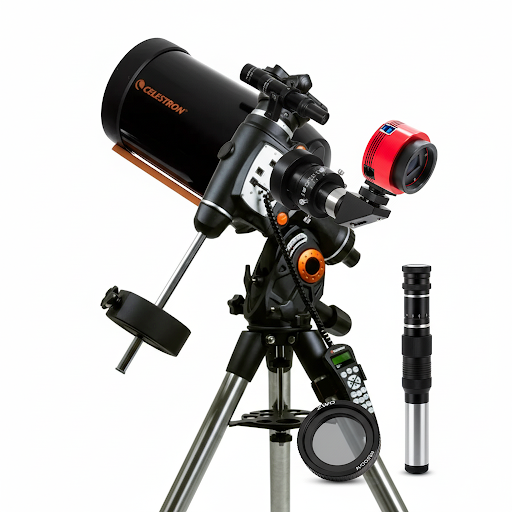
The Smart Planetary Imaging Bundle brings together five core components — a Celestron 8-inch Schmidt-Cassegrain optical tube, a Celestron Advanced VX equatorial mount, a ZWO ASI585MC color planetary camera, a Televue 2.5x Powermate, and a ZWO IR850 infrared filter. Together, these five pieces form a complete planetary imaging system that covers everything from initial setup to capturing high-resolution video of the planets and Moon.

Every component in this bundle is chosen for compatibility and performance. You do not need to worry about whether the camera fits the telescope or whether the mount handles the load. Sky Deep has already matched everything. The total system weight is approximately 53.6 lbs, well within the Advanced VX mount's capacity.

Component 1 — Celestron SCT 8" Optical Tube Assembly

The telescope is always the starting point. The Smart Planetary Imaging Bundle uses the Celestron SCT 8" OTA. This is an 8-inch, 203mm aperture Schmidt-Cassegrain telescope operating at f/10.

Why 8 Inches Is a Smart Choice for Pakistan

An 8-inch aperture sits in a very practical sweet spot for Pakistani planetary imagers. It is large enough to gather serious light and deliver meaningful resolution. It is also small enough to cool down quickly. This matters more than most beginners realize.

When you bring a telescope outside from a warm room, the optical tube needs time to reach the same temperature as the outside air. Until it does, heat rising from the mirror creates turbulence inside the tube. This ruins image sharpness. An 8-inch SCT cools down in roughly 30 to 45 minutes. Larger telescopes take much longer. For Pakistani observers who want to start imaging quickly after sunset, the C8's cool-down time is a genuine practical advantage.

The theoretical resolution limit of an 8-inch telescope is approximately 0.57 arc seconds. Under Pakistan's typical seeing conditions — which vary from moderate to good depending on location and season — this aperture resolves Jupiter's main cloud belt structure, the Cassini Division in Saturn's rings, and surface albedo features on Mars during opposition.

Schmidt-Cassegrain Optical Design

The C8 uses the same folded optical path as larger SCTs. Light enters through a corrector plate. It bounces off the primary mirror to the secondary, then back through the primary to the rear focuser. This gives the C8 a native focal length of 2032 mm in a compact, portable tube. The long focal length creates a large image scale at the camera sensor. Planets appear big enough in the frame for detail capture without needing extreme magnification at the eyepiece.

Celestron XLT Coatings

The C8 optics carry Celestron's StarBright XLT coatings on both mirrors and the corrector plate. These coatings maximize light transmission across the visible spectrum and into the near-infrared. For planetary imaging with the ZWO IR850 filter included in this bundle, good near-infrared transmission is directly useful. The XLT coatings also reduce internal scatter, which improves contrast in the final image.

Component 2 — Celestron Advanced VX Equatorial Mount

The mount in the Smart Planetary Imaging Bundle is the Celestron Advanced VX, also called the AVX. This is the same mount used in the Solar Imaging Bundle available at Sky Deep, which shows how capable it is across different imaging applications.

German Equatorial Design for Planetary Tracking

The AVX is a German Equatorial Mount. You align one axis — the right ascension axis — with Earth's rotational pole. After this polar alignment, the mount compensates for Earth's rotation automatically. Your target planet stays centered in the camera frame without constant manual adjustment. For planetary video capture, where you record thousands of frames over several minutes, this tracking accuracy is essential.

Payload Capacity

The Advanced VX handles up to 30 lbs of imaging equipment. The C8 OTA weighs approximately 11 lbs. Adding the camera, Powermate, and IR filter keeps the total imaging payload well under the mount's limit. Operating comfortably below the maximum payload keeps tracking smooth and accurate throughout the session.

GoTo Computerized System

The AVX includes a hand controller with a GoTo database of over 40,000 objects. For planetary imaging, you use GoTo to slew directly to your target. The mount moves automatically and centers the planet in your field of view. This is especially useful in light-polluted Pakistani city skies where finding planets manually through a high-focal-length telescope takes time and patience.

Solar Tracking Rate

The AVX supports solar, sidereal, and lunar tracking rates. For planetary imaging, you generally use the sidereal rate. For daytime solar work if you later add a solar filter, the solar tracking rate keeps the Sun centered accurately. The availability of multiple tracking rates makes the AVX a versatile mount for all Solar System targets.

Component 3 — ZWO ASI585MC Color Planetary Camera

The camera is the imaging heart of the Smart Planetary Imaging Bundle. The ZWO ASI585MC is a color CMOS planetary camera built around the Sony IMX585 sensor. Sky Deep is Pakistan's only authorized ZWO dealer, so this camera carries full ZWO manufacturer warranty and genuine product certification.

Sony IMX585 Sensor — Why It Matters

The IMX585 is a back-illuminated sensor. Back-illuminated, or BSI, means the light-sensitive layer of the sensor faces the incoming light directly. The wiring and readout circuitry sit behind the sensor layer instead of in front of it. This removes the wiring as an obstacle to incoming light. Back-illuminated sensors therefore capture more photons per pixel than front-illuminated sensors of the same size. More photons mean higher sensitivity and lower noise at the same exposure setting.

For planetary imaging, sensitivity matters because you use very short exposures — typically one to five milliseconds per frame. Short exposures freeze atmospheric turbulence in each frame. However, short exposures also mean less light per frame. A high-sensitivity sensor like the IMX585 captures enough light at these short exposure times to give you clean, usable frames even for fainter planetary features.

Sensor Resolution and Pixel Size

The ASI585MC sensor has a resolution of 8.3 megapixels. The pixel size is 2.9 microns. At the C8's native focal length of 2032 mm, this gives an image scale of approximately 0.29 arc seconds per pixel. This image scale is slightly finer than the theoretical resolution of the 8-inch aperture, which is ideal. You want your pixel scale to be slightly finer than your telescope's resolution limit so you are not undersampling the image. With the 2.5x Powermate added, the effective focal length becomes 5080 mm, giving an image scale of approximately 0.12 arc seconds per pixel — excellent for capturing fine planetary and lunar detail.

High Frame Rate via USB 3.0

The ASI585MC connects via USB 3.0 and captures up to 130 frames per second at full resolution. For planetary video, high frame rates give you more data to work with during brief windows of good atmospheric seeing. When the air steadies for a few seconds, the ASI585MC captures hundreds of frames in that window. Processing software then selects and stacks the sharpest frames. More frames in less time means more chance of catching the planet at its sharpest.

Color Camera Advantage for Beginners

Unlike the monochrome ASI174MM in the Advanced Planetary Imaging Bundle, the ASI585MC captures color directly. You do not need separate filter captures for each channel. One video gives you a full-color result immediately. This simplifies your workflow significantly, especially when you are still learning planetary capture and processing. You focus on getting sharp, well-exposed video rather than managing multi-channel filter sequences.

Dynamic Range

The IMX585 sensor has a dynamic range of approximately 81 dB. For planetary imaging, this wide dynamic range handles the brightness difference between Saturn's bright rings and its darker polar regions, or between the bright limb of Jupiter and the subtle contrast in its cloud bands. Good dynamic range means you capture both bright and dark features in the same frame without blowing out highlights or losing shadow detail.

Component 4 — Televue 2.5x 1.25" Powermate

The Televue 2.5x Powermate is the magnification tool in the Smart Planetary Imaging Bundle. It extends the effective focal length of the C8 from 2032 mm to approximately 5080 mm.

Why You Need Extra Focal Length for Planets

Planets are small objects in the sky. Even Jupiter, the largest planet, spans only about 50 arc seconds at its maximum apparent size during opposition. At 2032 mm focal length with 2.9-micron pixels, Jupiter covers roughly 170 pixels across its diameter. That sounds reasonable. However, planetary imaging benefits from larger image scale because stacking and sharpening techniques work better when the planet occupies more pixels. With the Powermate pushing the focal length to 5080 mm, Jupiter spans over 400 pixels. Fine detail that would merge into adjacent pixels at shorter focal length becomes resolvable.

Televue Optical Quality

Televue Powermates use a four-element optical design. This corrects the aberrations that simple two-element Barlows introduce at high magnification. The extra optical elements maintain the collimated light path from the telescope, meaning the image quality at 5080 mm effective focal length stays sharp and well-corrected from center to edge of the planetary disk. For a Pakistani imager capturing Saturn's ring detail, this optical quality difference is visible in the final stacked image.

1.25 Inch Format

The Powermate uses the standard 1.25-inch format. It fits directly into the C8's rear cell and accepts the ZWO ASI585MC camera at the other end. The ZWO IR850 filter threads onto the camera's 1.25-inch nosepiece between the Powermate and camera. The complete optical train connects cleanly without any additional adapters.

Component 5 — ZWO IR850 Infrared Bandpass Filter

The ZWO IR850 filter passes infrared light at 850 nanometers and blocks shorter visible wavelengths. This specific filter is an important addition to the Smart Planetary Imaging Bundle for Pakistani observers.

Why Infrared Helps Pakistani Planetary Imagers

Pakistan's atmosphere — especially above cities like Lahore, Karachi, and Islamabad — carries dust, haze, and humidity. These atmospheric conditions scatter shorter wavelengths of visible light more than longer wavelengths. Blue and green light scatter significantly. Red and infrared light pass through more cleanly.

When you image planets through the IR850 filter, you capture light at 850 nanometers. This wavelength cuts through atmospheric haze much more effectively than visible light. The result is sharper planetary images even on nights when visible-light seeing is mediocre. Furthermore, atmospheric dispersion — the color smearing effect caused by Earth's atmosphere — disappears completely when you image in a single infrared wavelength. There is no color separation to cause smearing.

The IR850 filter works especially well with the ASI585MC because the Sony IMX585 sensor has strong infrared sensitivity. Many color cameras use an infrared-cut filter to block IR light for natural-color daytime photography. The ASI585MC is designed for astronomy and retains strong sensitivity into the near-infrared range. Therefore, the IMX585 and the IR850 filter work together very efficiently.

What IR850 Images Show

Jupiter IR850 images show the planet's thermal emission structure and methane absorption features differently than visible-light images. The equatorial belts show high contrast. Saturn's rings show strong brightness differentiation between the A and B rings. Lunar IR850 images show exceptional surface contrast because different minerals on the Moon's surface reflect infrared light differently from visible light. The combination of IR850 imaging with the C8's resolution and the ASI585MC's sensitivity produces some of the sharpest lunar and planetary results achievable from Pakistani rooftops.

Technical Specifications at a Glance

Component Specification
Telescope Celestron SCT 8" OTA
Optical Design Schmidt-Cassegrain
Aperture 203mm (8 inches)
Focal Length 2032mm native / ~5080mm with Powermate
Focal Ratio f/10 native
Mount Celestron Advanced VX German Equatorial
Mount Payload Up to 30 lbs
Camera ZWO ASI585MC Color CMOS
Camera Sensor Sony IMX585 Back-Illuminated
Sensor Resolution 8.3 Megapixels
Pixel Size 2.9 microns
Frame Rate Up to 130 fps full resolution
Dynamic Range ~81 dB
Connection USB 3.0
Barlow Televue 2.5x 1.25" Powermate
Filter ZWO IR850 Infrared Bandpass (1.25")
Total System Weight ~53.6 lbs (24.3 kg)
Price Rs. 812,250 PKR

What Comes in the Box?

  1. Celestron SCT 8" Optical Tube Assembly
  2. Celestron Advanced VX Equatorial Mount with tripod
  3. ZWO ASI585MC Color Planetary Camera
  4. Televue 2.5x 1.25" Powermate
  5. ZWO IR850 Filter (1.25")
  6. All required cables, adapters, and documentation

What Can You Capture With Smart Planetary Imaging Bundle?

The Smart Planetary Imaging Bundle delivers real results on Solar System targets. Here is what becomes achievable from Pakistan with this system.

Jupiter — North and South Equatorial Belts with band structure, the Great Red Spot during transit, festoons, ovals, and the four Galilean moons. IR850 imaging reveals methane band contrast in the polar regions.

Saturn — Rings with the Cassini Division clearly visible as a dark gap between the A and B rings. Surface banding on the disk. Shadow of the rings on the planet body during certain orbital geometries. The IR850 filter shows strong ring brightness variation.

Mars — During opposition, surface albedo features including Syrtis Major and Hellas are within reach of 8-inch aperture. The polar ice caps show clearly in IR850 images because of high contrast between ice and surrounding terrain.

The Moon — Detailed lunar imaging is where this bundle particularly excels. The C8's focal length combined with the Powermate gives a large lunar image scale. Craters, rilles, mountain ranges, and mare boundaries all show fine structure. IR850 lunar images show mineral composition variation across different surface regions.

Smart Bundle vs Advanced Bundle — Which One Is Right for You?

Sky Deep stocks two planetary imaging bundles. The Smart Planetary Imaging Bundle uses an 8-inch telescope, a color camera, and a simpler workflow. The Advanced Planetary Imaging Bundle uses an 11-inch telescope, a monochrome camera, LRGB filter wheel, ADC, EAF, and ASIAIR Mini for a fully automated professional workflow.

The Smart Bundle suits you if you are entering planetary imaging seriously for the first time and want a capable, manageable system without the complexity of multi-channel filter capture and full automation. The Advanced Bundle suits you if you already understand LRGB processing, want maximum resolution, and need the automation tools for consistent long-session imaging.

Both bundles use ZWO cameras, and Sky Deep is Pakistan's only authorized ZWO dealer. You can explore the full Solar/Lunar/Planetary Imaging collection on Sky Deep, browse Uncooled Cameras and Camera Accessories for future upgrades, or check Schmidt-Cassegrain Telescopes to compare OTA options. For a free gear consultation to choose between the two bundles based on your experience level and goals, reach the Sky Deep team through the Contact Us page.

According to ZWO's official ASI585MC product page, the IMX585 back-illuminated sensor delivers exceptional sensitivity and dynamic range specifically optimized for high-speed planetary and lunar video capture — making the ASI585MC one of the most popular color planetary cameras among intermediate imagers worldwide.

Frequently Asked Questions

Is the Smart Planetary Imaging Bundle good for someone who has never imaged before?

Yes, with some preparation. This bundle is best for someone who has used a telescope visually and understands basic operation, polar alignment, and GoTo use. If you are completely new to telescopes, start with a consultation from Sky Deep's team through the Contact Us page. They will guide you on the right starting point for your experience level.

What software do I use to capture and process planetary videos?

Use SharpCap or FireCapture to record videos through the ASI585MC. After capturing, use AutoStakkert to align and stack your best frames. Then use Registax or ImPPG for wavelet sharpening to bring out fine detail. All these tools are free to download and have active online communities with tutorials.

Can I use this bundle for deep-sky astrophotography as well?

The C8 and AVX mount can support entry-level deep-sky work, but this bundle is optimized for planetary and lunar imaging. For serious deep-sky photography, you need a cooled camera and longer exposure capability. Sky Deep stocks a full range of Deep Space Imaging equipment if you want to expand into that area.

Why does the bundle include an IR850 filter instead of a visible-light filter?

 Pakistan's atmosphere above cities contains significant haze and dust. The IR850 filter cuts through this much more effectively than visible-light filters. It also eliminates atmospheric dispersion completely since you image in a single wavelength. For Pakistani observers, IR850 imaging consistently produces sharper planetary results than visible-light imaging on the same night.

Does Sky Deep offer free delivery on the Smart Planetary Imaging Bundle?

Yes. Sky Deep provides free nationwide delivery across Pakistan. Pre-order booking is available with 10% to 20% advance payment, and pre-orders ship within 4 to 6 weeks. Visit Sky Deep to place your order or book a free consultation with the team before purchasing.

View full details