Sky Deep
Lunt 80 mm Universal Day & Night Telescope (LS80MT)
SKU:LS80MT/R&P
In stock
Couldn't load pickup availability
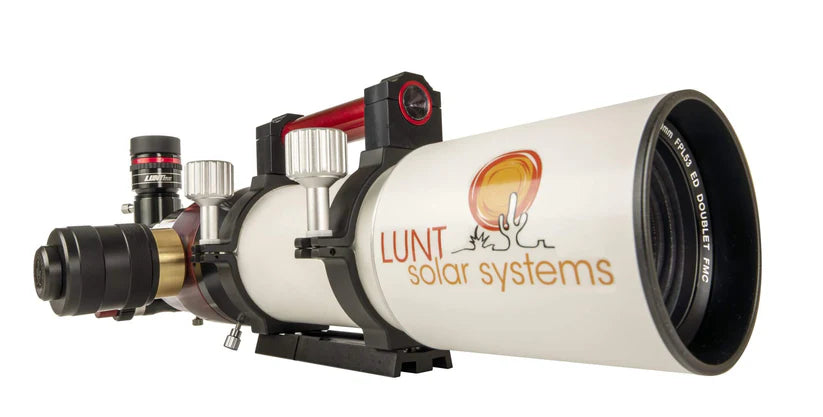
Most telescopes do one thing. You either use them for solar work or you use them at night. You cannot switch between the two. That is a real limitation, especially when you are spending serious money on equipment. The Lunt 80 mm Universal Day & Night Telescope LS80MT breaks that rule completely. This telescope works in both modes. It images the Sun in H-alpha during the day. At night, it switches to a high-quality ED refractor for planets, the Moon, and deep-sky objects. One telescope, two completely different worlds.
This is also the same telescope included in the Solar Imaging Bundle available at Sky Deep. If you want the full solar imaging system with mount and camera, that bundle is worth checking. But if you want just the telescope to pair with your existing equipment, the Lunt 80 mm Universal Day & Night Telescope LS80MT is available separately at Rs. 1,196,430 from Sky Deep Co
What Makes This Telescope Different?
The key word in the name is "Universal." Lunt Solar Systems designed the LS80MT to be a modular instrument. You can add the H-alpha etalon system for daytime solar work. Then you remove it and use the same optical tube at night for stars, planets, and nebulae. Most solar telescopes cannot do this. They are dedicated solar instruments only. The LS80MT gives you both capabilities in one package.
This matters in Pakistan because equipment is expensive and importing astronomy gear takes time. Buying one telescope that covers two completely different use cases makes financial sense. You get your solar imaging capability and your nighttime capability from a single optical tube.
The Optical System — FPL-53 ED Doublet
Let's talk about the optics first. The Lunt 80 mm Universal Day & Night Telescope LS80MT uses an FPL-53 ED doublet objective. There are two very important things here — FPL-53 and ED. Let's explain both.
What Is ED Glass?
ED stands for Extra-low Dispersion. Normal glass bends different colors of light at slightly different angles. Red light bends a little differently than blue light. This causes chromatic aberration — that colored fringe you sometimes see around bright objects in cheaper telescopes. ED glass minimizes this problem. It bends all colors of light much more uniformly. The result is sharper images with much better color accuracy across the whole spectrum.
What Is FPL-53?
FPL-53 is a specific type of ED glass made by Ohara in Japan. It is considered one of the best optical glasses available for telescope objectives. It has an extremely low refractive index dispersion. This means it corrects chromatic aberration better than most other ED glasses on the market. Many premium apochromatic telescopes use FPL-53 as the key element in their optical design. Lunt uses it here for a very specific reason — H-alpha imaging demands color-accurate, high-contrast optics.
When you image the Sun in H-alpha, you are working at a very specific wavelength — 656.28 nanometers. Any chromatic aberration near this wavelength reduces contrast and sharpness. FPL-53 glass keeps the optical system corrected right at the H-alpha wavelength. This directly improves the quality of your solar images.
Focal Length and Focal Ratio
The LS80MT has a focal length of 560 mm and a focal ratio of f/7. This combination is very useful for both solar and nighttime work. The f/7 ratio is fast enough to give you a reasonable field of view for visual observing. It is also long enough to give good image scale for solar and planetary imaging. For astrophotography at night, f/7 works well with most cameras without needing a field flattener for smaller sensors.
Ion-Assist Broadband Anti-Reflection Coatings
The objective lens carries ion-assist broadband anti-reflection coatings. These coatings reduce light loss at each glass surface. Without coatings, every glass surface reflects a small percentage of incoming light back out. With broadband AR coatings applied using ion-assist technology, reflectance drops dramatically. More light reaches your eye or camera sensor. This improves image brightness and contrast for both solar and nighttime use.
The H-Alpha Etalon System — What It Does and How It Works
This is the most technically advanced part of the Lunt 80 mm Universal Day & Night Telescope LS80MT. Understanding the etalon system helps you get the most from it.
What Is an Etalon?
An etalon is a precision optical filter made from two parallel glass surfaces with an extremely precise gap between them. Light bounces between these surfaces multiple times. Only light at a very specific wavelength passes through cleanly. All other wavelengths cancel out through destructive interference. The result is an incredibly narrow band of light — in this case, centered on the H-alpha wavelength at 656.28 nanometers.
Bandpass — Single Stack vs Double Stack
The LS80MT etalon delivers a bandpass of less than 0.65 Angstroms in single-stack configuration. One Angstrom is one ten-billionth of a meter. Passing less than 0.65 of these means the etalon filters light to an extraordinarily thin slice of the spectrum. This produces high contrast solar views with excellent prominence and filament visibility.
When you add a second etalon — called double-stack configuration — the bandpass narrows further to less than 0.45 Angstroms. Double-stack dramatically increases surface contrast. Surface granulation, plages, and fine filament structures become much more visible. The trade-off is some reduction in image brightness, but the increase in detail is significant. Many serious solar imagers prefer double-stack for surface detail work.
Doppler-True Barometric Pressure Tuning
This is a feature that separates professional-grade solar telescopes from consumer ones. The LS80MT etalon uses Doppler-true barometric pressure tuning. Here is what that means.
The Sun's surface is not static. Different parts of the solar disk move toward or away from you at different velocities. This causes a Doppler shift in the H-alpha wavelength from different areas of the disk. Conventional tuning systems shift the etalon's passband uniformly, which optimizes one area of the disk but de-optimizes others.
Barometric pressure tuning works differently. Changing the air pressure inside the sealed etalon housing shifts the optical path length. This shifts the passband. Lunt's system is "Doppler-true" — the tuning curve matches the actual Doppler shift profile of the solar disk more accurately than mechanical tilt-tuning systems. In practice, this means more uniform contrast across the full solar disk when you tune the etalon.
Blocking Filter
The H-alpha etalon alone is not enough for safe solar viewing. You also need a blocking filter. The blocking filter sits at the focuser end of the optical system. It blocks any residual off-wavelength light that passes the etalon. The LS80MT comes with a blocking filter as part of the package — either B1200 or B1800 depending on the variant you select.
The blocking filter model number refers to its clear aperture in tenths of a millimeter. B1200 has a 12mm clear aperture. B1800 has an 18mm clear aperture. The larger blocking filter is important when you use cameras with larger sensors or when you want to use a 2-inch diagonal for visual work. Always check which blocking filter is included in your chosen variant before ordering.
Safety reminder: Always use the blocking filter when observing or imaging the Sun. Never use the telescope for solar work without the etalon and blocking filter properly in place. The LS80MT is engineered as a safe system when used correctly as a complete unit.
Modular Design — Three Package Variants
The Lunt 80 mm Universal Day & Night Telescope LS80MT comes in different package configurations. Lunt calls these Starter, Observer, and Advanced. Each variant includes different focuser options and accessory combinations.
Focuser Options
The LS80MT is available with three focuser types depending on the variant you choose.
Dual-Speed Crayford Focuser — A Crayford focuser uses a smooth drawtube running against a rotating cylinder. There is no rack and pinion gear mechanism. This gives very smooth, slop-free focusing motion. The dual-speed version adds a fine adjustment knob for precise focus control. Crayford focusers work very well for imaging where precise focus is critical.
Dual-Speed Rack & Pinion Focuser — This is the traditional focuser design. A toothed rack meshes with a pinion gear. Rack and pinion focusers handle heavier loads without slipping. For visual use with heavier eyepieces or diagonals, rack and pinion provides solid, reliable focus control without the risk of the focuser slipping under load.
Dual-Speed Feather Touch Focuser — This is an upgrade option. Feather Touch focusers from Starlight Instruments are considered the best manual focusers available. They use a proprietary design that combines the smoothness of a Crayford with the load-bearing capability of a rack and pinion. If you plan heavy use for astrophotography, the Feather Touch variant offers the most precise and reliable focuser experience.
Mounting — CNC Rings and Vixen Dovetail
The LS80MT comes with CNC-machined mounting rings and a Vixen-style dovetail plate. CNC machining produces very precise, consistent mounting rings. The Vixen dovetail is the standard format for telescope mounts. It fits virtually all equatorial and alt-azimuth mounts that use a standard Vixen saddle. If you own an equatorial mount with a Vixen saddle, the LS80MT mounts directly without any adapters.
Nighttime Performance — ED Refractor for Stars and Planets
When you remove the H-alpha etalon system, the Lunt 80 mm Universal Day & Night Telescope LS80MT becomes a high-quality 80mm ED refractor for nighttime use. The FPL-53 objective and 560mm focal length give you sharp, color-accurate views of planets, the Moon, double stars, and bright deep-sky objects.
At 80mm aperture and f/7, this telescope works well for:
Planetary Viewing — Jupiter's cloud bands, Saturn's rings, and Mars surface markings are all visible under good seeing conditions. The FPL-53 optics keep color fringing minimal, which is especially important for high-contrast planetary detail.
The Moon — Lunar detail is outstanding through the LS80MT at night. The 560mm focal length gives a useful image scale for crater detail without excessive magnification on mid-range eyepieces.
Double Stars — The 80mm aperture resolves many close double star pairs. The sharp, color-corrected optics make double star splitting satisfying at higher magnifications.
Bright Deep-Sky Objects — The Orion Nebula, Pleiades, and other bright objects fit nicely in the field of view at lower magnifications. For faint deep-sky imaging, 80mm aperture has limits, but for visual observing of showpiece objects it performs well.
The telescope also works for terrestrial and daytime land viewing. The included diagonal and adapters allow you to use it as a high-quality spotting scope during the day when you are not doing solar work.
Hard Case — Storage and Transport
The Lunt 80 mm Universal Day & Night Telescope LS80MT ships with an aluminum finished hard case with fitted foam interior. This is a practical inclusion for Pakistani astronomers who travel to observing sites outside cities. The foam protects the optical tube and accessories from transport damage. The aluminum shell handles rough handling during travel. For anyone carrying equipment to Murree hills, coastal sites, or desert locations for dark sky imaging, this case matters.
Technical Specifications at a Glance
| Specification | Detail |
|---|---|
| Aperture | 80mm |
| Objective | FPL-53 ED Doublet |
| Focal Length | 560mm |
| Focal Ratio | f/7 |
| H-alpha Wavelength | 656.28 nm |
| Bandpass (Single Stack) | Less than 0.65 Angstroms |
| Bandpass (Double Stack) | Less than 0.45 Angstroms |
| Etalon Tuning | Doppler-true barometric pressure tuning |
| Optical Coatings | Ion-assist broadband anti-reflection |
| Focuser Options | Dual-speed Crayford / Rack & Pinion / Feather Touch |
| Mounting | CNC rings, Vixen-style dovetail |
| OTA Weight | Approximately 9.25 lbs (4.2 kg) |
| Storage | Aluminum hard case with fitted foam |
| Price | Rs. 1,196,430 PKR |
What Comes in the Box?
- Lunt LS80MT 80mm Universal Telescope OTA
- Blocking filter (B1200 or B1800 depending on variant)
- 1.25" night star diagonal and/or terrestrial diagonal (package dependent)
- 2" to 1.25" adapter where applicable
- 19mm flat-field eyepiece (varies by kit)
- Focuser assembly (chosen variant)
- Red dot sun finder and handle assembly
- Vixen-style dovetail mounting plate
- Aluminum hard case with fitted foam
- Documentation and quick start guide
Note: Exact contents depend on the Starter, Observer, or Advanced package you select. Confirm the SKU details before ordering to make sure you get the blocking filter size and focuser type you need.
Who Should Buy the Lunt LS80MT?
The Lunt 80 mm Universal Day & Night Telescope LS80MT is for astronomers who want serious H-alpha solar capability without buying a telescope that is useless at night. It suits intermediate to advanced users who understand the value of FPL-53 optics and H-alpha imaging. It is also the right choice for someone building a solar imaging setup piece by piece, pairing it with their existing equatorial mount and camera.
If you want the complete ready-to-image solar system with mount and camera already included, the Solar Imaging Bundle includes this telescope alongside the Celestron AVX mount and ZWO ASI676MC camera. That bundle takes the guesswork out of compatibility.
For a free consultation on which option suits your setup and budget, reach the Sky Deep team through the Contact Us page. You can also browse the full range of Solar/Lunar/Planetary Imaging equipment and Apochromatic Telescopes on Sky Deep to compare options before deciding.
According to Lunt Solar Systems{rel="nofollow"}, the LS80MT series represents their most versatile solar telescope design, combining precision H-alpha solar optics with full nighttime ED refractor capability in a single modular instrument.
Frequently Asked Questions
Can I use the Lunt LS80MT for nighttime deep-sky astrophotography?
Yes. When you remove the H-alpha etalon, the LS80MT works as an 80mm f/7 ED refractor. It performs well for lunar, planetary, and bright deep-sky imaging at night. For serious deep-sky photography, Sky Deep stocks a full range of Deep Space Imaging equipment to complement your setup.
What is the difference between the B1200 and B1800 blocking filter?
The number refers to the clear aperture in tenths of a millimeter. B1200 gives a 12mm clear aperture and suits 1.25-inch visual use and small camera sensors. B1800 gives an 18mm clear aperture and works better with larger camera sensors and 2-inch visual accessories. Choose based on your camera sensor size and the accessories you plan to use.
What does double-stack mean and do I need it?
Double-stack means adding a second etalon to narrow the bandpass from less than 0.65 Angstroms to less than 0.45 Angstroms. This dramatically improves surface detail contrast. If your main interest is solar surface features like granulation and filaments, double-stack gives noticeably better results. For prominence imaging, single-stack already performs very well.
Which focuser variant should I choose?
For visual observing, the rack and pinion handles heavier eyepieces without slipping. For imaging with a camera, the Crayford gives smooth precise focus control. The Feather Touch is the premium option for serious astrophotographers who want the best possible focusing precision. Contact Sky Deep for a recommendation based on your specific setup.
Does Sky Deep offer free delivery on the Lunt LS80MT?
Yes. Sky Deep provides free nationwide delivery across Pakistan. Pre-order booking is available with 10% to 20% advance payment. Pre-orders ship within 4 to 6 weeks. Visit Sky Deep to place your order or book a free gear consultation before purchasing.