Skip to product information
1 of 1

Optolong

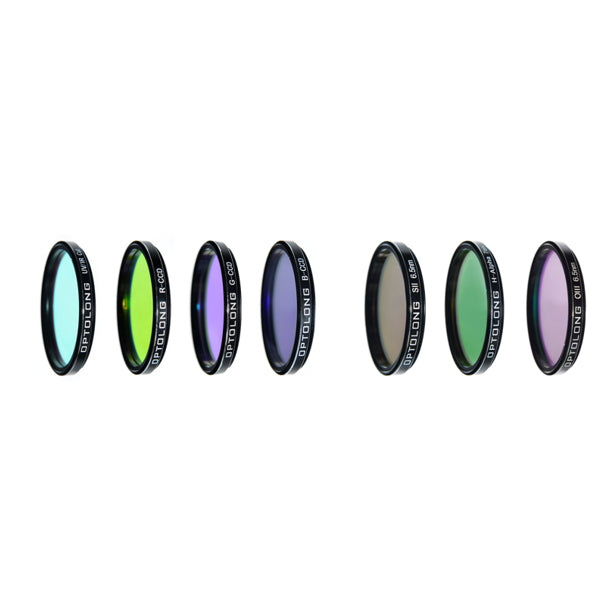
Optolong 1.25" Filter Set with LRGB, H-Alpha, SII, and OIII Filters

Optolong 1.25" Filter Set with LRGB, H-Alpha, SII, and OIII Filters

Regular price Rs.189,525 PKR
Regular price Sale price Rs.189,525 PKR
Sale Sold out

SKU:OTL-LRGB-HASIIOIII-200

In stock

Quantity

You have been imaging for a while now. Your color camera gives decent results. But somewhere in the back of your mind, you know β€” real deep-sky data comes from a monochrome sensor with dedicated filters.

That is exactly what the ZWO ASI6200MM-P USB3.0 Full-Frame Cooled Monochrome Camera gives you. A full-frame Sony IMX455 sensor, active cooling down to -35Β°C below ambient, and a 61.2 megapixel resolution that captures nebulae and galaxies in extraordinary detail.

Sky Deep Co is the only authorized ZWO dealer in Pakistan. Every ZWO product you buy here activates under full ZWO warranty. Cameras bought from any other source in Pakistan do not qualify for ZWO activation. Visit Sky Deep Co β€” Pakistan's Only Authorized ZWO Dealer for Astronomy Cameras before you buy anything.

Why Monochrome Beats Color for Deep-Sky Imaging

A color camera has a Bayer matrix on top of the sensor. This mosaic blocks certain wavelengths for each pixel. You lose sensitivity in the process.

A monochrome camera has no Bayer matrix at all. Every single pixel captures every wavelength of light. This makes monochrome sensors 2 to 3 times more sensitive than equivalent color cameras in the same conditions.

When you pair a monochrome camera with dedicated narrowband filters, you isolate precise emission lines β€” Hydrogen-Alpha, Oxygen III, Sulphur II. The result is data no color camera can match, especially under light-polluted skies like Lahore or Karachi.

Sky Deep Co's own blog explains this perfectly β€” read How Narrowband Filters Cut Through City Light Pollution for Astrophotography to understand exactly why Pakistani astrophotographers are switching to monochrome setups.

Full Technical Specifications

Specification Detail
Sensor Sony IMX455 BSI CMOS
Resolution 61.2 MP (9576 Γ— 6388)
Pixel Size 3.76 Β΅m
Sensor Size Full Frame (35.6 Γ— 23.8 mm)
Read Noise 1.0e– (min)
Full Well Capacity 51,400e–
Dynamic Range 14.1 stops
Cooling Active TEC β€” up to -35Β°C below ambient
QE Peak ~91%
ADC 16-bit
Interface USB 3.0
Anti-Dew Heater Built-in
Weight ~700g

The back-side illuminated (BSI) design of the IMX455 means light hits the photodiode directly without passing through circuitry first. This pushes the peak quantum efficiency to 91% β€” meaning 91 out of every 100 photons hitting the sensor actually get recorded. That is exceptional performance for deep-sky work.

What the ZWO ASI6200MM-P Does That Other Cameras Cannot

Full-frame coverage. Most astronomy cameras use smaller APS-C or Micro Four Thirds sensors. The ASI6200MM-P gives you a full 35.6 Γ— 23.8mm imaging circle. This means you capture large nebulae in a single frame without mosaics. The Orion Nebula, the Rosette Nebula, the California Nebula β€” all fit comfortably with the right focal length.

Ultra-low read noise at 1.0e–. Read noise is the electronic noise added every time the sensor reads out data. At 1.0 electrons, the ASI6200MM-P is practically silent electronically. Short exposures become useful data. You stack more frames without noise stacking up with them.

16-bit ADC gives you 65,536 tonal levels. The difference between a bright nebula core and the faint outer shell can be subtle. 16-bit depth captures both ends of that range without clipping highlights or losing shadow detail. This is why processed images from this camera show incredible tonal gradients.

Who Should Use the ZWO ASI6200MM-P

You are an advanced astrophotographer ready for serious data. You understand stacking, calibration frames, and narrowband processing. This camera rewards that knowledge with data quality that competes with observatory-grade equipment.

You image emission nebulae from light-polluted cities. Narrowband filters on a monochrome sensor make Lahore's Bortle 9 sky workable. Several Pakistani astrophotographers have already done this β€” you can see their results on the Sky Deep Moments β€” Real Astrophotography by Pakistani Imagers gallery.

Optolong 2" Filter Set with LRGB, H-Alpha, SII, and OIII Filters

A monochrome camera without filters is like a painter without colors. The camera records light. The filters decide which light gets through. Together, they produce images that look like they came from a space observatory.

The Optolong 2" Filter Set with LRGB, H-Alpha, SII, and OIII Filters gives you all seven filters you need in one complete kit. Four broadband LRGB filters for true-color imaging. Three narrowband filters for SHO and HOO palette work. One purchase covers every major imaging workflow a serious astrophotographer uses.

What Each Filter Actually Does

Understanding your filters means understanding your data. Here is what each one captures.

Luminance (L) passes all visible light without a color bias. You use this for the sharpest, highest-detail layer of your image. It forms the structural foundation in LRGB processing.

Red, Green, Blue (RGB) isolate their respective wavelengths to build natural color information. Combined with the L frame in software like PixInsight or Astro Pixel Processor, LRGB produces true-color galaxy and star cluster images with excellent star color accuracy.

H-Alpha at 7nm isolates the 656nm emission line of ionized hydrogen. This is the dominant glow of almost every emission nebula. It cuts through light pollution better than any other filter because city lights rarely emit at exactly 656nm.

OIII at 6.5nm captures the 500nm emission of doubly ionized oxygen. It reveals the outer shells of planetary nebulae and adds contrast to complex nebula structures that H-Alpha alone does not show.

SII at 6.5nm captures the 672nm emission of ionized sulphur. It adds the third channel needed for the famous Hubble palette β€” SII as red, H-Alpha as green, OIII as blue β€” producing those stunning false-color nebula images you have seen from professional observatories.

Full Technical Specifications

Specification Detail
Filter Size 50.8mm (2 inch)
Shape Round, Threaded
Thread M48 Γ— 0.75
H-Alpha Bandwidth 7nm @ 656nm
OIII Bandwidth 6.5nm @ 500nm
SII Bandwidth 6.5nm @ 672nm
Glass Schott optical glass
Housing CNC-machined aluminum
Coatings Multi-layer anti-reflection, ion-assisted deposition
Surface Quality 60/40 scratch-dig
IR Blocking 700nm to 1100nm blocked
Clear Aperture Full 2" (full-frame sensor compatible)

The ion-assisted deposition coating process bonds each layer of coating at the molecular level. This makes coatings far more durable than standard vacuum-deposited alternatives. You clean these filters regularly over years of use and the coatings hold up without scratching or degrading.

The Schott glass substrate is the same material used in professional optical instruments. It has extremely tight tolerances for flatness and parallelism. This matters because a filter that is not perfectly flat introduces astigmatism into your star images, especially at fast focal ratios.

Why This Set Works Especially Well in Pakistan

Pakistan has a serious light pollution problem in every major city. Lahore, Karachi, Islamabad β€” all sit at Bortle 7 to Bortle 9 on the light pollution scale. Broadband RGB imaging from these cities is very difficult because sky glow overwhelms faint targets.

Narrowband filters change everything. The 7nm H-Alpha passband is so narrow that it blocks nearly all sodium and LED street lighting. Your signal-to-noise ratio improves dramatically. Targets that are invisible in broadband become clearly structured in narrowband even from city rooftops.

This is exactly what the Sky Deep Co blog covers in detail. Read How Narrowband Filters Help in Astroimaging Under Urban Skies β€” A Guide for Pakistani Astrophotographers to see the real difference filters make from a light-polluted location.

Q: Is the ZWO ASI6200MM-P compatible with filter wheels and narrowband filter sets?

Yes. The camera uses a standard M54 front thread and works with all major filter wheels including ZWO's own EFW series. Pair it with a full LRGB and narrowband filter set for complete SHO and HOO palette imaging. Explore the Optolong LRGB and Narrowband Filter Sets β€” Complete 7-Filter Kit for Monochrome Cameras available at Sky Deep Co for an excellent pairing.

Q: Do these Optolong filters work with color cameras or only monochrome cameras?

These 2-inch filters are designed primarily for monochrome cameras used with a filter wheel. For color camera users, a dual-band or multi-band clip-in filter is usually a better fit. Browse the Narrowband Filters β€” Single and Dual Band Options for Every Camera Type collection to compare all available options. Also check Broadband LRGB Filter Sets β€” True Color Imaging for Monochrome Cameras if you need only the LRGB portion.

Q: What is the SHO Hubble palette and can I create it with this filter set?

Yes, absolutely. The SHO palette assigns Sulphur-II to the red channel, H-Alpha to green, and Oxygen-III to blue. The Hubble Space Telescope made this palette famous with images like the Pillars of Creation. This Optolong set includes all three narrowband filters you need to replicate that workflow on your own data.

Q: What telescope pairs best with the ZWO ASI6200MM-P in Pakistan?

Apochromatic refractors are the top pairing choice for full-frame monochrome imaging. They deliver flat fields with no coma or aberration across the large sensor. Browse Apochromatic Telescopes β€” Color-Accurate Imaging Optics for Monochrome Cameras to find compatible options at Sky Deep Co.

You want one camera that handles everything. LRGB for galaxies. H-Alpha for emission nebulae. OIII for planetary nebulae. SII for Hubble palette composites. One camera, multiple filters, unlimited targets.

Explore all available ZWO cameras on the ZWO Astronomy Cameras β€” Full Range of ZWO Products in Pakistan brand page. And if you need help choosing between models, the Sky Deep Co Cooled Monochrome Cameras Collection shows every option side by side.

Q: Why does cooling matter so much in a monochrome astronomy camera?

Heat generates noise in CMOS sensors. This thermal noise appears as random bright pixels in your data, called hot pixels. Cooling the sensor down to -35Β°C below ambient dramatically reduces this noise. Your dark frames become cleaner, your stacked images get sharper, and your faint nebula details come through much more clearly.

Pairing This Filter Set With the Right Camera and Telescope

This set was built for monochrome cameras. The ZWO ASI6200MM-P USB3.0 Full-Frame Cooled Monochrome Camera is the natural pairing at the top end. The full 2-inch clear aperture covers full-frame sensors completely with zero vignetting.

For your telescope, an apochromatic refractor gives the best results at fast focal ratios. The narrowband filters perform at their best when the optics deliver flat, well-corrected fields. Visit the Optolong Filters β€” Complete Brand Page at Sky Deep Co to see all available Optolong products.

Not sure which filter or camera combination suits your specific setup? Sky Deep Co offers free gear consultation for every customer. Contact the team through the Sky Deep Co Expert Astronomy Consultation Page β€” Free Gear Advice Before You Buy and get a personalized recommendation.

View full details