Celestron
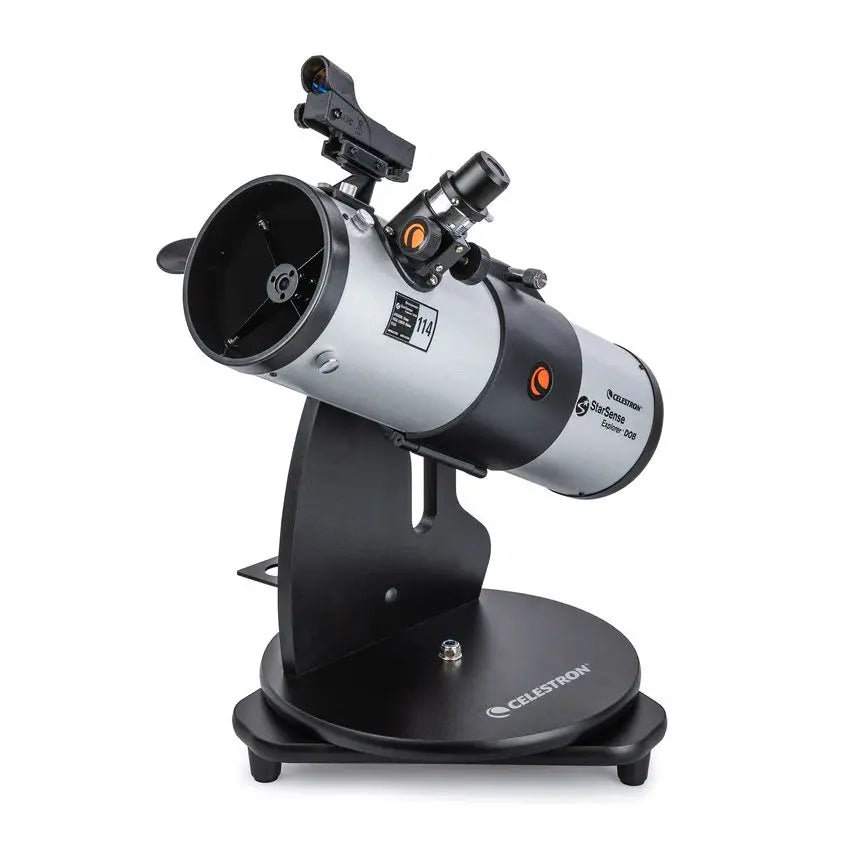
Celestron StarSense Explorer 114mm Tabletop Dobsonian Telescope
Celestron StarSense Explorer 114mm Tabletop Dobsonian Telescope
SKU:
Out of stock
Couldn't load pickup availability
Product Description
The Celestron StarSense Explorer 114mm Tabletop Dobsonian Telescope is a compact, beginner-friendly telescope designed to make stargazing easy and enjoyable. Its 114mm parabolic mirror delivers bright, detailed views of the Moon, planets, star clusters, and other deep-sky objects, while the StarSense Explorer app helps you locate celestial targets quickly using your smartphone.
The portable tabletop Dobsonian mount provides smooth manual movement and quick setup, making it ideal for home, travel, and outdoor observing. Whether you're new to astronomy or looking for a convenient telescope, the Celestron StarSense Explorer 114mm Tabletop Dobsonian Telescope offers reliable performance, easy navigation, and an excellent observing experience.
Technical Specifications
| Specification | Details |
|---|---|
| Optical Design | Newtonian Reflector with Parabolic Primary Mirror |
| Aperture | 114 mm (4.5") |
| Focal Length | 450 mm |
| Focal Ratio | f/3.9 |
| Mount Type | Manual Alt-Azimuth Tabletop Dobsonian |
| Navigation System | StarSense Explorer Smartphone App |
| Star Finding | Plate-Solving Technology (No Motors Required) |
| Focuser | 1.25" Rack-and-Pinion Focuser |
| Finderscope | StarPointer™ Red Dot Finder |
| Included Eyepieces | 17 mm and 10 mm Kellner Eyepieces |
| Highest Useful Magnification | 269× |
| Tube Material | Steel Optical Tube |
| Best For | Moon, Planets, Nebulae, Galaxies & Star Clusters |
| User Level | Beginner to Intermediate |
What the Celestron StarSense Explorer 114mm Dobsonian Shows You
The 114mm parabolic primary mirror gives this telescope genuine light-gathering capability beyond entry-level instruments. At this aperture, the Moon delivers dramatic crater detail along the terminator. Saturn's rings appear as a clearly separated structure. Jupiter resolves its equatorial bands and shows all four Galilean moons as distinct points. Additionally, brighter deep-sky objects — the Orion Nebula, the Andromeda Galaxy, the Pleiades, and the Beehive Cluster — reveal real structure rather than appearing as uniform smudges.
The 450mm focal length at f/3.9 makes this a fast, wide-field instrument. Objects are bright and well-framed rather than cramped and dim. As a result, the telescope performs well even under moderately light-polluted suburban skies — which is the reality for most observers in Pakistani cities.
The included 17mm and 10mm Kellner eyepieces cover a practical range of magnifications to get started. When you are ready to expand your eyepiece collection, the eyepieces and Barlows range at Sky Deep includes compatible 1.25-inch options that pair naturally with this focuser.
The Tabletop Design of the Celestron StarSense Explorer 114mm — Practical by Intention
The tabletop Dobsonian base keeps the entire setup low, stable, and fast. You place it on any flat surface — a garden table, a rooftop ledge, a car bonnet — and it is ready to observe in under three minutes. There is no tripod to extend, no polar alignment to perform, and no counterweight to balance.
The sturdy alt-azimuth rocker box moves smoothly in both axes, which is important because the StarSense system relies on the observer manually nudging the telescope to follow on-screen arrows. A stiff or jerky mount makes that process frustrating. This base is neither — it tracks your hand movements fluidly and holds position when you stop.
Before your first session, Sky Deep's beginner's guide to setting up and using a telescope walks through the initial assembly steps and first-night habits that make the experience far smoother for new owners.
Choosing the Celestron StarSense Explorer 114mm — Who It Is Right For
This telescope occupies a specific and valuable position in the beginner market. It suits someone who wants to observe meaningful targets on their very first night — not after weeks of learning star charts. It equally fits families where children and adults share the telescope, since the app interface makes navigation understandable regardless of prior experience.
If you are still weighing different telescope designs before deciding, Sky Deep's expert guide on how to buy your first telescope by Dr. Ahmed Naeem covers aperture, mount types, and optical designs in plain language — specifically written for Pakistani observers making this decision for the first time. Additionally, for a broader comparison of optical designs, the reflector vs refractor telescopes guide on the Sky Deep blog explains where a fast Newtonian reflector like this one performs best.
Pakistan's astronomy community has grown significantly in recent years. Societies like the Karachi Astronomers Society, the PakAstronomers Islamabad, and observers connected through the Lahore Astronomy Group regularly recommend smartphone-assisted telescopes as a confidence-building entry point — particularly for urban observers dealing with light pollution and unfamiliar skies.
Explore the full Celestron beginners telescope collection at Sky Deep Co. and book a free consultation to discuss whether this model matches your specific goals and observing conditions.
Frequently Asked Questions
Q1. Which smartphones are compatible with the StarSense Explorer app?
Most Android (2016+) and iPhone 6 or newer devices are compatible.
Q2. Does the StarSense app require an internet connection?
No, it works offline after the initial download.
Q3. What can I see with the 114mm telescope?
You can observe the Moon, planets, star clusters, the Orion Nebula, and the Andromeda Galaxy.
Q4. How is StarSense different from a GoTo telescope?
StarSense guides you to objects using your smartphone, while you manually move the telescope.
Q5. Does Sky Deep provide after-sales support?
Yes, Sky Deep offers lifetime technical support for setup, app calibration, and telescope guidance.