Astrodon
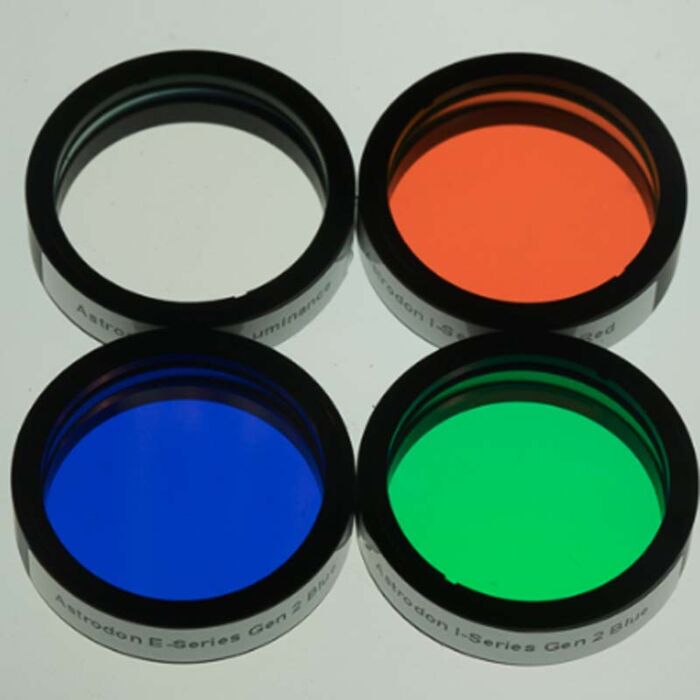
Astrodon 1.25" Gen2 I-Series LRGB Filter Set – Mounted
Astrodon 1.25" Gen2 I-Series LRGB Filter Set – Mounted
SKU:ASTRODON-LRGB-125-GEN2-I
Available Soon
Couldn't load pickup availability
Product Description
The Astrodon 1.25" Gen2 I-Series LRGB Filter Set – Mounted is a premium LRGB filter set designed for monochrome CCD astrophotography. Engineered for balanced RGB transmission, these mounted filters deliver accurate colour reproduction, excellent contrast, and reduced star halos for stunning deep-sky images. Their parfocal design minimizes refocusing between filters, making them an ideal choice for capturing galaxies, nebulae, and star clusters with professional results.
Technical Specifications
| Specification | Details |
|---|---|
| Brand | Astrodon |
| Product Type | LRGB Filter Set |
| Model | Gen2 I-Series |
| Filter Size | 1.25" Mounted |
| Filter Set | Luminance, Red, Green & Blue |
| Filter Diameter | 31 mm |
| Cell Diameter | 49.7 mm |
| Substrate | 3 mm ±0.025 mm Fused Silica |
| Surface Flatness | 1/4 Wave |
| Parallelism | 30 Arcseconds |
| Coating | Ultra-Hard Sputtered Coatings |
| Filter Design | Parfocal |
| Made In | USA |
| Warranty | 5 Years |
What's Included in the Box
The package includes the Astrodon 1.25" Mounted Gen2 I-Series Luminance, Red, Green, and Blue filters, securely packaged for safe storage and transport, along with official warranty documentation.
Why Buy from Sky Deep Co?
Buy the Astrodon 1.25" Gen2 I-Series LRGB Filter Set – Mounted from Sky Deep Co, Pakistan's trusted astronomy retailer. We are the Official Authorized Partner of ZWO and the Official Authorized partner of Celestron in Pakistan, offering 100% genuine astronomy equipment backed by an official local warranty and dependable after-sales support. Our experienced team provides expert consultation, technical guidance, and nationwide delivery, helping you choose the right equipment for your astrophotography setup.
FAQs
1.Is this filter set suitable for colour cameras?
No, it is designed specifically for monochrome CCD cameras.
2. What filters are included?
The set includes Luminance, Red, Green, and Blue (LRGB) mounted filters.
3. Are these filters parfocal?
Yes, the filters are parfocal, reducing the need to refocus between filter changes.
4. What type of astrophotography is this filter set best for?
It is ideal for deep-sky imaging, including galaxies, nebulae, and star clusters.
5. Does Sky Deep Co provide warranty support?
Yes, Sky Deep Co provides an official warranty and reliable after-sales support for genuine products.