Sky Deep
Advanced Planetary Imaging Bundle
SKU:SOLAR?LUNAR?PLANETARY-003
In stock
Couldn't load pickup availability
There is a big difference between taking a photo of Jupiter and actually resolving its cloud bands, storm systems, and the Great Red Spot in sharp detail. The first one is easy. Any telescope with a basic camera can do that. The second one requires the right aperture, the right mount, the right camera, and the right accessories — all working together perfectly. The Advanced Planetary Imaging Bundle from Sky Deep gives you exactly that. Every component in this bundle is chosen specifically for one goal — maximum resolution planetary and lunar imaging.
This is not a beginner setup. It is a professional-class planetary imaging platform. If you are serious about capturing Jupiter, Saturn, Mars, and the Moon at the highest resolution possible from Pakistan, this bundle is built for you. It is available at Rs. 2,251,500 from Sky Deep with free nationwide delivery.
What Is the Advanced Planetary Imaging Bundle?
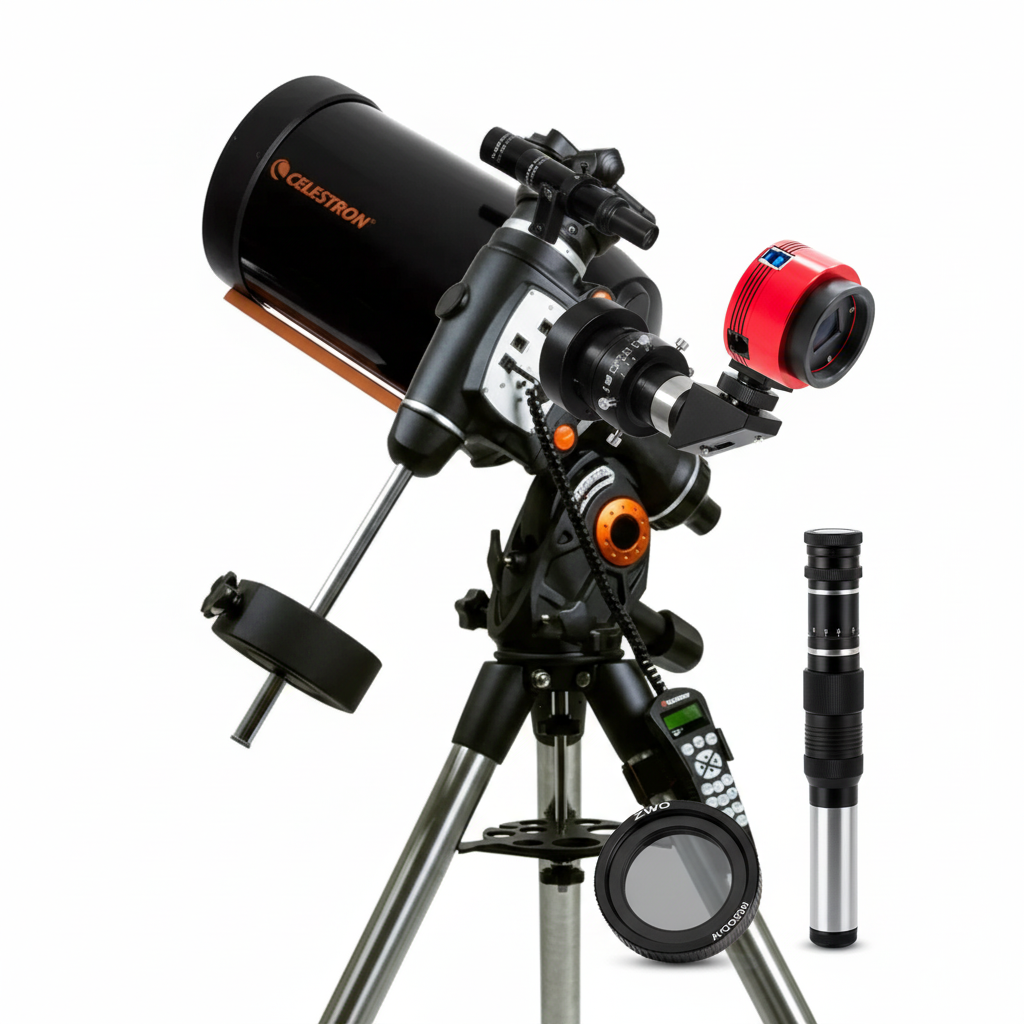
The Advanced Planetary Imaging Bundle combines ten carefully matched components into one complete planetary imaging system. You get a large aperture Schmidt-Cassegrain telescope, a heavy-duty computerized German equatorial mount, a high-speed monochrome planetary camera, an electronic filter wheel, LRGB and IR filters, an atmospheric dispersion corrector, an electronic automatic focuser, a wireless imaging controller, and a precision Barlow lens.
Every piece connects to the others. The system is designed to work as a single integrated unit. You do not need to research compatibility or buy extra adapters. Sky Deep has already done that work. The bundle is ready to set up and start imaging from your first session.
Component 1 — Celestron SCT 11" Optical Tube Assembly
The telescope is the foundation of any imaging setup. The Advanced Planetary Imaging Bundle uses the Celestron SCT 11" Optical Tube Assembly. This is the optical tube only — no mount included here, because the bundle pairs it with the purpose-matched CGX-L mount separately.
Aperture — Why 11 Inches Matters for Planets
Aperture controls two things for planetary imaging — light gathering and resolution. For planets, resolution is the critical factor. Resolution defines how much fine detail the telescope can separate. A larger aperture separates finer details. The theoretical resolution limit of an 11-inch telescope is approximately 0.42 arc seconds. That is enough to resolve features on Jupiter, Saturn, and Mars that smaller telescopes simply cannot show.
Pakistan's atmosphere limits practical resolution below the theoretical maximum. However, during good seeing nights — especially in winter months — an 11-inch aperture consistently outperforms smaller instruments. More aperture always wins when the atmosphere cooperates.
Schmidt-Cassegrain Optical Design
The C11 uses a Schmidt-Cassegrain design. Light enters through a corrector plate at the front. It hits a large primary mirror at the back. Then it reflects forward to a smaller secondary mirror mounted on the corrector plate. The secondary sends the light back through a hole in the primary mirror to the focuser at the rear. This folded path gives the C11 a very long effective focal length — 2800 mm — inside a compact tube.
2800 mm of focal length at f/10 gives excellent image scale for planetary work. Planets appear large in the camera frame. This large image scale is exactly what you need to resolve fine detail with a small-pixel camera like the ZWO ASI174MM included in this bundle.
High-Contrast Optics
Celestron builds the C11 with XLT optical coatings on all mirror and lens surfaces. These coatings increase light transmission and reduce scatter inside the optical tube. For planetary imaging, scattered light reduces contrast. High-contrast optics mean your images show cleaner separation between bright and dark features — cloud bands on Jupiter appear more distinct, ring divisions on Saturn look sharper.
Component 2 — Celestron CGX-L German Equatorial Mount
A telescope is only as good as the mount holding it. For an 11-inch SCT, you need a mount that is rigid, accurate, and capable of carrying serious weight. The Advanced Planetary Imaging Bundle includes the Celestron CGX-L — one of Celestron's most capable German equatorial mounts.
Payload Capacity
The CGX-L handles up to 75 lbs of equipment. The C11 OTA weighs approximately 26 lbs. With a camera, filter wheel, focuser, ADC, and Barlow attached, the total imaging train reaches around 35 to 40 lbs. The CGX-L handles this comfortably. Operating well below the maximum payload keeps the mount stable and tracking accurately throughout a long imaging session.
Precision Tracking and CGX-L's Drive System
The CGX-L uses precision worm gear drives on both axes. These drives move the telescope to compensate for Earth's rotation. For planetary video capture, you need the planet to stay centered in the camera frame for minutes at a time. The CGX-L's tracking keeps this consistent without constant manual correction. Periodic error — small tracking irregularities in the worm gear — is low enough in the CGX-L that it does not affect short-exposure planetary captures.
Computerized GoTo System
The CGX-L has a built-in GoTo computer with a database of over 40,000 objects. For planetary imaging, this means you slew to your target planet automatically. The mount finds it and centers it in the field of view. With the ZWO ASIAIR Mini also included in this bundle, plate solving further refines centering automatically. You spend your time imaging, not searching.
Polar Alignment Accuracy
Accurate polar alignment is important for long capture runs. The CGX-L includes a built-in polar alignment scope through the right ascension axis. This makes precise polar alignment straightforward even in the field. Accurate polar alignment keeps your target from drifting out of the camera frame during extended imaging sessions.
Component 3 — ZWO ASI174MM Monochrome Camera
The camera is the imaging core of the Advanced Planetary Imaging Bundle. The ZWO ASI174MM is one of the most respected planetary cameras available. Sky Deep is Pakistan's only authorized ZWO dealer. This means your camera carries full manufacturer warranty and genuine ZWO quality.
Why Monochrome for Planets?
The ASI174MM is a monochrome camera — it captures no color information on its own. Every pixel measures only brightness. This seems like a disadvantage. But for planetary imaging, monochrome is actually superior to color.
A monochrome sensor uses every single pixel for light information. A color sensor places a color filter over each pixel — red, green, or blue. This means a color sensor only captures about one-third of the available light per channel and requires software to reconstruct full resolution color. A monochrome sensor gives you full resolution on every pixel for every channel when you use separate color filters. The result is sharper, more detailed images.
With the LRGB filter set included in this bundle, you capture separate luminance, red, green, and blue channel videos. You combine these in processing to create a final color image that has higher resolution and better signal-to-noise than any color camera can produce at equivalent settings.
Sony IMX174 Sensor
The ASI174MM uses the Sony IMX174 global shutter CMOS sensor. Global shutter is a specific feature that matters for planetary imaging. Most camera sensors use rolling shutter — they read pixel rows one at a time from top to bottom. During this read time, the image can shift slightly due to atmospheric turbulence. This causes a slight warping of the image called "rubber banding."
The IMX174 global shutter reads all pixels simultaneously at exactly the same moment. There is no row-by-row delay. Every frame captures a frozen snapshot of the planet at one precise instant. This eliminates rubber banding completely. Your sharpest frames are truly sharp, with no geometric distortion from the shutter mechanism itself.
Sensor Size and Pixel Size
The IMX174 sensor measures 11.3 mm diagonally. The pixel size is 5.86 microns. At the C11's native focal length of 2800 mm, this gives an image scale of approximately 0.43 arc seconds per pixel. This matches well with the theoretical resolution of the 11-inch aperture. The planet fills a useful portion of the sensor without being too small for detail or too large to fit.
Frame Rate
The ASI174MM captures up to 164 frames per second at full resolution via USB 3.0. For planetary imaging, high frame rates are critical. You capture thousands of frames in a short time window when the atmosphere is steady. Processing software like AutoStakkert selects the sharpest percentage of these frames and stacks them. More frames in less time means more quality data during brief moments of good atmospheric seeing.
Component 4 — ZWO 5-Position Electronic Filter Wheel
Changing filters manually between LRGB captures introduces vibration and focus shift. The Advanced Planetary Imaging Bundle includes the ZWO 5-Position Electronic Filter Wheel to solve this completely.
The EFW holds five 1.25-inch filters and rotates to any position electronically. You control it from the ASIAIR Mini. When you capture an LRGB sequence, the ASIAIR commands the filter wheel to rotate to the correct filter automatically between each channel capture. There is no touching the telescope. There is no vibration. The filter changes happen in seconds. Furthermore, the EFW's repeatability means each filter sits in exactly the same position every time, keeping your focus consistent across channels.
Component 5 — ZWO LRGB 1.25" Filter Set and IR Bandpass Filter
The filter set in the Advanced Planetary Imaging Bundle serves two purposes — color channel separation and infrared luminance detail.
LRGB Filters
The LRGB set contains four filters — Luminance, Red, Green, and Blue. Each filter passes only its designated wavelength range. You capture a separate video through each filter. In processing, you combine these channels to create a full-color image. The luminance channel carries the fine detail. The RGB channels provide accurate color information. Combining them using LRGB processing gives you both sharp detail and correct color in the final image.
IR Bandpass Filter
The infrared bandpass filter is an important addition for planetary imaging in Pakistan. Earth's atmosphere scatters blue light more than red or infrared light. This atmospheric scattering reduces sharpness, especially when planets are at lower altitudes above the horizon. Infrared light passes through atmospheric turbulence more cleanly than visible light. Therefore, an IR video captured through the IR bandpass filter often shows finer detail than any visible-light channel during the same seeing conditions. Many serious planetary imagers use IR as a high-resolution luminance layer in their final processing workflow.
Component 6 — ZWO Atmospheric Dispersion Corrector
Atmospheric dispersion is one of the most overlooked problems in planetary imaging from Pakistan. When a planet sits below about 40 degrees altitude, Earth's atmosphere acts like a weak prism. It bends red light at a slightly different angle than blue light. The result is a tiny spectrum stretched across the planet's image — red on one edge, blue on the other. This color smearing reduces sharpness across all channels and makes LRGB alignment difficult in processing.
The ZWO Atmospheric Dispersion Corrector, or ADC, corrects this problem in real time before the light reaches your camera. The ADC contains two counter-rotating glass prisms. You adjust their relative rotation to introduce an equal and opposite dispersion that cancels the atmospheric effect. The correction is tunable — you dial in more correction for lower altitude targets and less for targets higher in the sky. After ADC correction, all color channels align accurately and the planet's image is sharp from edge to edge.
The ADC sits in the optical train between the telescope focuser and the camera. It works with the Powermate and filter wheel without needing special adapters. For Pakistani observers imaging planets at moderate altitudes, the ADC is not optional — it is essential for getting the sharpest possible results.
Component 7 — ZWO Electronic Automatic Focuser
Focus drift is a constant problem for planetary imaging. Temperature changes during a session cause the telescope tube to expand or contract slightly. This shifts focus. Without an automatic focuser, you must manually refocus every few minutes. This interrupts capture sessions and introduces vibration every time you touch the focuser knob.
The ZWO Electronic Automatic Focuser, or EAF, replaces manual focusing completely. It attaches to your focuser drawtube and moves it in precise, measured steps using a motor controlled by the ASIAIR Mini. The EAF remembers focus positions for each filter. When you switch filters, it moves to the saved focus position automatically. Furthermore, the EAF supports temperature compensation. It measures the ambient temperature and adjusts focus continuously as temperature changes through the night. You set up your focus at the start of the session and the EAF maintains it automatically for hours.
Component 8 — ZWO ASIAIR Mini
The ASIAIR Mini is the central controller that connects and automates the entire imaging system. It is a small wireless device that you attach to your telescope. It connects to your camera, filter wheel, focuser, and mount simultaneously. You control everything from a tablet or smartphone using the ASIAIR app over WiFi.
Capture Sequencing
You program a complete LRGB capture sequence from your phone. The ASIAIR captures L, R, G, B, and IR channels automatically in the order and duration you set. It rotates the filter wheel, controls the camera exposure, and saves files to an attached storage device. You set it up once and it runs without further input.
Plate Solving
Plate solving is an automated method of precisely identifying where the telescope is pointing by matching stars in the camera image to a star catalog. The ASIAIR Mini performs plate solving automatically after every GoTo command. If the telescope slews to Jupiter and it is slightly off-center, the ASIAIR identifies the exact field coordinates and nudges the mount to center the target perfectly. This accuracy is especially useful for setting up capture at the start of each session.
Cable Simplification
Instead of running separate USB cables from your camera, filter wheel, and focuser to a laptop, everything connects to the ASIAIR Mini through short cables. The ASIAIR connects wirelessly to your phone. This dramatically reduces cable clutter on the telescope, which in turn reduces flex and vibration during capture.
Component 9 — Televue 2.5x Powermate
The Televue 2.5x Powermate multiplies the effective focal length of the C11 by 2.5. The C11's native focal length is 2800 mm. With the Powermate, the effective focal length becomes 7000 mm. At this focal length, Jupiter fills a large, detail-rich area of the ASI174MM sensor. Small features like the Great Red Spot, festoons, and oval storm systems become resolvable when seeing conditions allow.
The Televue Powermate uses a four-element optical design that preserves the collimated light path more accurately than standard two-element Barlows. This means the magnification is clean — no edge softening, no introduced aberrations. The image quality at 7000 mm effective focal length remains sharp from center to edge of the planetary disk.
Technical Specifications at a Glance
| Component | Specification |
|---|---|
| Telescope | Celestron SCT 11" OTA |
| Optical Design | Schmidt-Cassegrain |
| Aperture | 279mm (11 inches) |
| Focal Length | 2800mm native / ~7000mm with Powermate |
| Focal Ratio | f/10 native |
| Mount | Celestron CGX-L German Equatorial |
| Mount Payload | Up to 75 lbs |
| Camera | ZWO ASI174MM Monochrome |
| Camera Sensor | Sony IMX174 Global Shutter CMOS |
| Pixel Size | 5.86 microns |
| Frame Rate | Up to 164 fps at full resolution |
| Connection | USB 3.0 |
| Filter Wheel | ZWO 5-Position Electronic (1.25"/31mm) |
| Filters Included | ZWO LRGB 1.25" Set + ZWO IR Bandpass |
| Dispersion Corrector | ZWO ADC |
| Focuser | ZWO Electronic Automatic Focuser (EAF) |
| Controller | ZWO ASIAIR Mini |
| Barlow | Televue 2.5x 1.25" Powermate |
| Price | Rs. 2,251,500 PKR |
What Comes in the Box?
- Celestron SCT 11" Optical Tube Assembly
- Celestron CGX-L German Equatorial Mount with tripod and counterweights
- ZWO ASI174MM USB 3.0 Monochrome Planetary Camera
- ZWO 5-Position Electronic Filter Wheel (1.25"/31mm)
- ZWO LRGB 1.25" Filter Set
- ZWO IR Bandpass Filter
- ZWO Atmospheric Dispersion Corrector
- ZWO Electronic Automatic Focuser
- ZWO ASIAIR Mini
- Televue 2.5x 1.25" Powermate
- Cables, adapters, and documentation
What Can You Capture With This Bundle?
The Advanced Planetary Imaging Bundle targets the Solar System's showpiece objects. Here is what becomes achievable under good Pakistani seeing conditions.
Jupiter — Cloud band detail including the North and South Equatorial Belts, the Great Red Spot, oval storm systems, festoons, and the four Galilean moons in their orbital positions. At 7000 mm effective focal length with the Powermate, Jupiter fills the sensor with room for fine detail capture.
Saturn — Ring structure including the Cassini Division, the B ring, and the inner C ring under excellent seeing. Surface banding on Saturn's disk and the shadow of the rings on the planet surface are all within reach of this aperture.
Mars — Surface albedo features including Syrtis Major and Hellas Basin during opposition. The polar ice caps are visible and distinguishable with LRGB processing.
The Moon — Sub-arcsecond lunar imaging reveals crater detail, rilles, mountain ranges, and dome structures at a level that approaches telescope resolution limits. IR channel imaging of the Moon through the IR bandpass filter produces exceptional contrast between highlands and mare regions.
Who Is This Advanced Planetary Imaging Bundle For?
The Advanced Planetary Imaging Bundle is for experienced astronomers who have moved past beginner equipment and want to produce genuinely high-quality planetary images. If you understand the basics of video capture, lucky imaging stacking, and LRGB processing — or you are ready to learn these techniques seriously — this bundle gives you the complete platform to do it at the highest level available for Pakistani observers.
You can explore the full range of Solar/Lunar/Planetary Imaging equipment on Sky Deep, browse Uncooled Cameras and Camera Accessories for future upgrades, or check Schmidt-Cassegrain Telescopes if you want to compare OTA options. For a free consultation on this bundle or any planetary imaging setup, reach the Sky Deep team through the Contact Us page before ordering.
According to ZWO's official product page{rel="nofollow"}, the ASI174MM is specifically optimized for high-speed solar, lunar, and planetary imaging with its global shutter IMX174 sensor — making it one of the most widely used planetary cameras among serious imagers worldwide.
Frequently Asked Questions
Is the Advanced Planetary Imaging Bundle suitable for beginners?
This bundle is designed for intermediate to advanced users. It works best when you already understand basic telescope operation, polar alignment, and video capture concepts. However, if you are a fast learner and committed to planetary imaging from the start, Sky Deep's free gear consultation can walk you through the learning curve. Reach the team through the Contact Us page for guidance.
Why does this bundle use a monochrome camera instead of a color camera?
Monochrome cameras use every pixel at full resolution for each channel. Color cameras split resolution across red, green, and blue pixels simultaneously. For maximum planetary detail, monochrome plus separate LRGB filters always produces sharper results than a color camera at equivalent sensor size. The ZWO ASI174MM monochrome sensor gives you the resolution advantage that serious planetary imaging requires.
What software do I need to process the images?
You capture planetary videos using the ASIAIR Mini app. For stacking and sharpening, AutoStakkert handles frame selection and stacking. Registax or ImPPG handles wavelet sharpening after stacking. WinJUPOS is useful for derotation of Jupiter captures. All of these tools are free to download and widely documented in the planetary imaging community.
Can I use the CGX-L mount for deep-sky imaging later?
Yes. The CGX-L is a capable mount for deep-sky astrophotography as well. Its high payload capacity and accurate tracking support long-exposure imaging with additional equipment. Sky Deep stocks a full range of Deep Space Imaging cameras and accessories if you want to expand your setup in that direction.
Does Sky Deep offer free delivery on this bundle?
Yes. Sky Deep provides free nationwide delivery across Pakistan on the Advanced Planetary Imaging Bundle. Pre-order booking is available with 10% to 20% advance payment. Pre-orders ship within 4 to 6 weeks. Visit Sky Deep to place your order or book a free consultation before purchasing.