Celestron
Celestron PowerSeeker 50 AZ Refractor
Celestron PowerSeeker 50 AZ Refractor
SKU:
Low stock: 3 left
Couldn't load pickup availability
Most people overthink their first telescope purchase. They read comparison charts, watch review videos, and eventually either buy nothing or spend far more than they needed to. The Celestron PowerSeeker 50 AZ Refractor cuts through all of that. No tools needed for setup, no alignment procedure to follow, and no prior knowledge required. You take it outside, point it at the Moon, and within ten minutes you are actually looking at craters.
Available at Sky Deep Co. — Pakistan's only authorized Celestron dealer — this is the telescope you hand to someone who has never touched one before and watch them figure it out on their own.
Why the Celestron PowerSeeker 50 AZ Refractor Starts With a Lens, Not a Mirror
A refractor uses lenses inside a sealed tube to focus light. That sealed design means dust stays out, alignment never drifts, and you never have to collimate anything. You just look. For someone new to astronomy, this removes a surprisingly common frustration — reflectors need occasional mirror alignment, and nothing kills enthusiasm faster than a blurry first night caused by a setup issue nobody warned you about.
The 50mm objective lens is fully coated, which reduces internal light scatter and improves contrast. On a steady night, Saturn's rings show up as a clearly separated structure. Jupiter resolves its disc and you can spot the Galilean moons beside it. The Moon, honestly, is what sells this telescope — craters, shadows, and the terminator line look genuinely impressive even at low magnification.
Still weighing refractors against reflectors before deciding? Sky Deep's guide on reflector vs refractor telescopes lays out the differences without jargon — written specifically for people buying their first scope in Pakistan.
Everything the Celestron PowerSeeker 50 AZ Packs Into the Box
Four eyepieces come included — 20mm, 12mm, 4mm, and a 1.5x image erecting eyepiece. That covers wide-field views all the way up to close planetary detail. A Barlow lens pushes that range even further. There is also a star diagonal, which makes a bigger difference than most beginners expect — observing near the zenith without one means contorting your neck into positions that end sessions early.
The adjustable tripod includes an accessory tray, and that tray is genuinely useful in the dark. When you are swapping eyepieces at night without a flashlight, having a flat surface at arm's reach prevents things from ending up in the grass.
Starry Night Basic software is also included — 36,000 objects, printable sky maps, and 3D star and galaxy renderings. It works well as a planning tool before heading outside.
Before your first session, Sky Deep's complete beginner guide to setting up a telescope walks through every step from unboxing to finding your first target — worth reading the night before you go out.
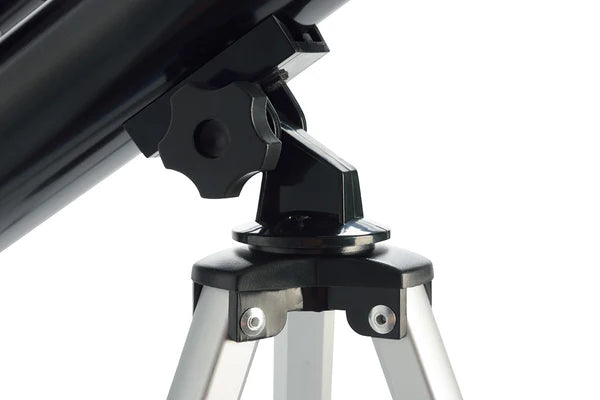
The Alt-Azimuth Mount on the Celestron PowerSeeker 50 AZ — Simple on Purpose
Alt-azimuth means up-down and left-right. That is it. No tilted axis, no polar alignment, no learning a coordinate system before you can point at the Moon. You move the tube where you want it and look. The mount has been the default design for casual visual telescopes for centuries — the telescope's history on Wikipedia traces how this simple pointing mechanism became the foundation of amateur astronomy long before motors and computers entered the picture.
Objects do drift through the field of view as the Earth rotates, so you nudge the tube every minute or two to keep them centered. At lower magnifications this is barely noticeable. At higher power it requires more attention — but honestly, that physical engagement with the sky is part of learning how it moves.
If you are setting up for younger observers, Sky Deep's guide on 5 essential telescope safety precautions for beginners is worth going through before the first session — practical habits that protect both the instrument and the person using it.
Who Actually Reaches for the Celestron PowerSeeker 50 AZ
Students, curious beginners, parents buying a first scope for a child, anyone who wants to see Saturn once and decide from there whether astronomy is for them. The PowerSeeker 50 AZ answers that question honestly. It shows you real things without asking much in return. At some point a 50mm aperture will feel limiting — that is fine, because by then you will know exactly what you want next and why.
For observing tips, product updates, and astronomy community news in Pakistan, the Sky Deep Co. Facebook page is worth following — the team posts regularly about new arrivals, celestial events visible from Pakistan, and guidance for observers at every level.
Browse the full Celestron PowerSeeker series at Sky Deep Co. and book a free gear consultation if you want an honest opinion on whether this model suits your goals or whether stepping up to a larger aperture makes more sense from the start.
Frequently Asked Questions
Q1. Is the Celestron PowerSeeker 50 AZ a good choice for a child's first telescope?
It is one of the more sensible options at this price level. The setup takes minutes without any tools, the tripod adjusts to different heights, and the included accessories give younger observers enough variety to stay engaged past the first night. The Moon alone tends to be enough to hold attention for weeks.
Q2. Can you actually see Saturn's rings and Jupiter's moons through this telescope?
Yes — on a clear steady night, both are genuinely visible. Saturn's rings appear separated from the disc, and Jupiter's four Galilean moons show up as small points beside the planet. These are the targets that tend to turn casual curiosity into a real hobby. Most people who see Saturn for the first time through any telescope remember it for years.
Q3. Does the mount track objects on its own?
No, it is fully manual. As the Earth rotates, objects drift out of the field of view — you nudge the tube to follow them. At lower magnifications this happens slowly enough that it is barely noticeable. At higher power it requires more active adjustment. This is normal for entry-level instruments and part of learning how the sky moves.
Q4. How much magnification is actually useful on a 50mm telescope?
Around 100x is the practical ceiling. Beyond that, you are magnifying turbulence and optical limits more than actual detail. The included eyepiece and Barlow combinations get close to this range, so the accessories provided cover everything the telescope can realistically deliver.
Q5. What kind of after-sales support does Sky Deep provide for this product?
Lifetime support — which in practice means you can contact Sky Deep Co. at any point after purchase for setup help, eyepiece recommendations, or upgrade advice. There is no time limit on that and no charge for consultation.