Tele Vue
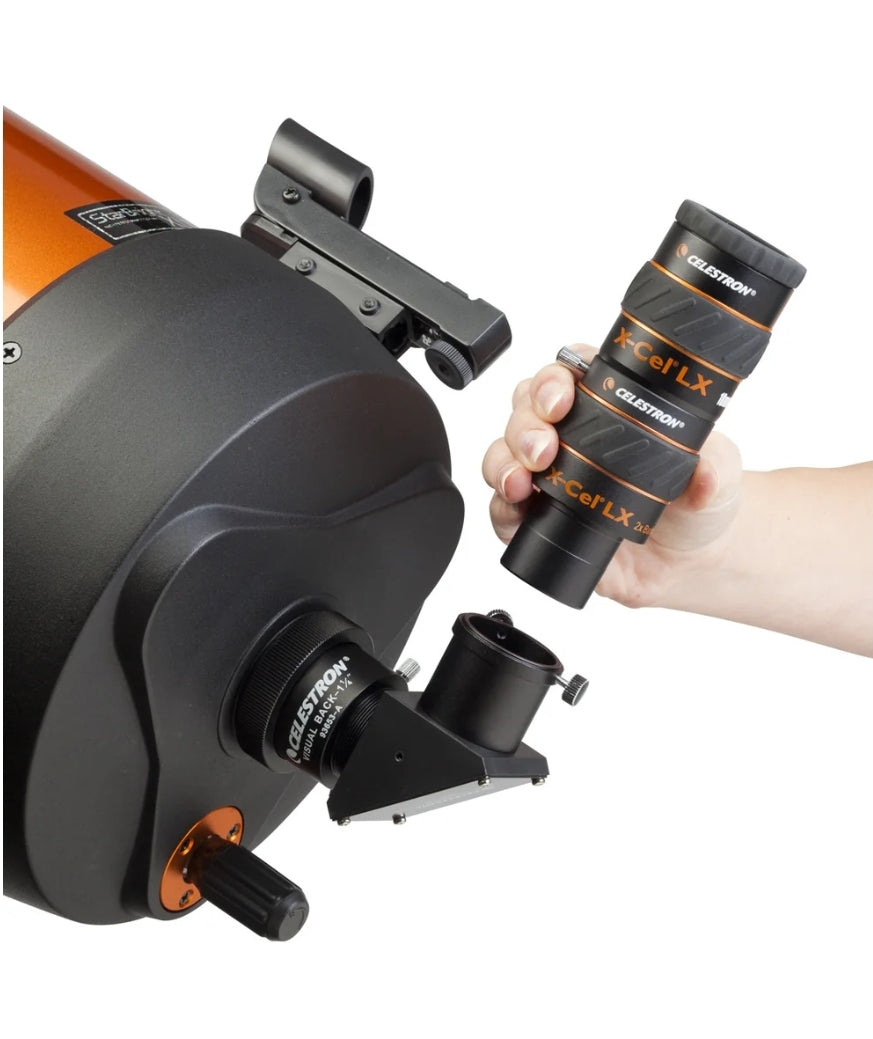
Celestron 2X 1.25" Barlow Lens
Celestron 2X 1.25" Barlow Lens
SKU:SDT-BLW-2125
Low stock: 3 left
Couldn't load pickup availability
Every astronomer reaches a point where the stars feel just a little too far. The craters on the Moon blur into each other. Jupiter's cloud bands refuse to separate cleanly. Saturn's rings look flat instead of three-dimensional. That moment is not a limitation of your telescope — it is simply a signal that you need a Barlow lens.
The Celestron 2X 1.25" Barlow Lens, available at Sky Deep Co. — Pakistan's only authorized Celestron dealer — is exactly what bridges that gap between what you see and what the sky is actually offering.
What Is a Barlow Lens and Why Does It Matter?
Before diving into what makes this specific Barlow stand out, it helps to understand the tool itself. A Barlow lens is an optical device that fits between your telescope's focuser and your eyepiece. When you insert it, it increases the effective focal length of your telescope — which directly multiplies your magnification. In the case of this 2X Barlow, every eyepiece you own instantly becomes twice as powerful.
Think of it this way: if you have a 25mm eyepiece giving you 50x magnification, that same eyepiece through this Barlow delivers 100x. Therefore, instead of buying multiple expensive eyepieces, you effectively double your entire eyepiece collection with a single, well-built accessory. For astronomers working on a budget — or even professionals who prefer traveling light — this is a remarkably practical upgrade.
Premium Optics That Actually Deliver
What separates a quality Barlow from a cheap one is the glass inside. The Celestron 2X 1.25" Barlow uses two multi-coated high-index glass elements that work together to extend your focal length without introducing chromatic aberration or edge distortion. Multi-coating on the glass reduces internal reflections, which means more light reaches your eye rather than scattering inside the barrel. As a result, your images stay sharp, contrasty, and bright — even at higher magnifications.
This level of optical care matters especially for planetary and lunar observation. When you are studying the terminator line across the Moon's surface or tracing the Cassini Division in Saturn's rings, any compromise in glass quality shows immediately. Consequently, the coated optics here make a visible difference on nights of good seeing.
Parfocal Design — Less Fuss, More Sky
One of the more frustrating experiences in visual astronomy is losing focus every time you switch between configurations. This Barlow is nearly parfocal, meaning you need little to no refocusing when you add it to your setup. You stay at the eyepiece longer. You lose fewer observing minutes. Overall, your session becomes smoother and more enjoyable — particularly during planetary transits or fast-moving events where every second counts.
Built for Both Visual Observers and Astrophotographers
Beyond visual use, this Barlow lens is also compatible with astronomy cameras. Depending on the camera's sensor position inside the barrel, you can achieve up to 3.5X magnification — a significant boost for planetary imaging. Photographers using a ZWO astronomy camera will find this Barlow a natural pairing for capturing fine planetary detail. Similarly, it works well alongside any eyepiece or Barlow accessory in your current setup.
The brass compression ring and captive thumbscrew hold your eyepiece or camera adapter firmly in place without scratching the barrel. Additionally, the 1.25" chrome barrel accepts standard filters, so you can stack solar or planetary filters with it without any compatibility issues.
Which Telescope Types Work Best With This Barlow?
Not every Barlow performs equally across all telescope designs. If you are still deciding on a telescope or unsure which optical design suits high-magnification work, the Sky Deep guide on Reflector vs Refractor Telescopes covers exactly how focal length, aperture, and optical design affect your magnification outcomes. Understanding those differences helps you use a Barlow more deliberately — not just more powerfully.
If you are working with a Schmidt-Cassegrain telescope, the longer native focal lengths make the 2X Barlow especially effective. SCTs already punch above their size in magnification, and adding this Barlow delivers outstanding planetary detail without any degradation in image quality.
Who Should Add This to Their Setup?
This Barlow suits beginners who want more power without upgrading their telescope. It equally benefits intermediate astronomers who already own a few eyepieces and want to extend their range. Since Pakistan has increasingly active astronomy communities — including the Lahore Astronomical Society, Karachi Astronomers Society, and the Pakistan Astronomical Society — more observers are now recognizing the value of quality optics at every level of their setup.
Final Thought
A good Barlow lens is one of the most cost-effective decisions in astronomy. Instead of spending on a new telescope, you simply deepen what your current one can already do. The Celestron 2X 1.25" Barlow Lens, backed by Sky Deep's authorized supply chain and expert support, gives you that deeper reach — reliably, clearly, and without compromise.
Explore the full astronomy accessories collection at Sky Deep Co. and book a free consultation if you need guidance on pairing this with your existing setup.
Frequently Asked Questions
Q1. Will this Barlow lens work with any telescope eyepiece I already own?
Yes — as long as your eyepiece has a standard 1.25" barrel, this Barlow fits directly and works without any adapter. Most entry-level and intermediate telescopes sold in Pakistan use this barrel size, so compatibility is rarely an issue.
Q2. Can I use this Barlow lens for astrophotography, or is it only for visual use?
It works for both. When paired with a camera, the magnification can reach up to 3.5X depending on how deep the sensor sits inside the barrel. Photographers using a ZWO planetary camera find it especially useful for capturing surface detail on Jupiter, Saturn, and the Moon.
Q3. Does using a Barlow lens reduce image brightness or sharpness?
A low-quality Barlow can, but this one uses multi-coated high-index glass elements that minimize light loss and internal reflections. Therefore, the image stays bright and sharp even at doubled magnification — provided your seeing conditions allow it.
Q4. Is the Celestron 2X Barlow suitable for a beginner who just bought their first telescope?
Absolutely. In fact, it is one of the first accessories most experienced astronomers recommend. Instead of purchasing several eyepieces at once, a beginner can simply pair this Barlow with one or two eyepieces and cover a wide range of magnifications from the start.
Q5. How do I know if a 2X Barlow is the right choice, or should I go for a 3X instead?
A 2X Barlow offers a more balanced result — you get doubled magnification without pushing into the range where atmospheric turbulence starts degrading the image. A 3X can be useful for very long focal length telescopes, but for most setups in Pakistan's urban and semi-urban environments, 2X delivers cleaner and more usable results more consistently.